Skip to content

How to Find the Best Fitness Apparel Manufacturer in China

Choosing a Fitness Apparel Manufacturer in China can shape product quality, delivery reliability, and the trust customers place in your brand. A polished website is only a starting point. The real test is whether the factory can produce your fabric, fit, stitching, and sizing consistently. As apparel supply-chain researcher Dr. Sheng Lu’s work suggests, supplier decisions should be grounded in evidence rather than broad claims. Treat that as a practical sourcing principle, not a direct quotation.

Look closely at the details. Ask who owns the production site, which processes are handled in-house, and which are subcontracted. Request recent samples, size specifications, fabric details, and clear answers about minimum order quantities and lead times. Compare the sample with the written specifications. A soft, supportive waistband may feel right in a showroom, yet lose shape after repeated washing. Small differences matter.

The best choice is rarely the supplier with the lowest quote or the fullest product catalog. Evaluate communication, sample accuracy, production capacity, and quality checks together. Ask how defects are recorded and corrected. Confirm that the company can provide relevant business and product documentation, then verify it independently where possible. A video call can help, but it cannot replace careful checks. No checklist removes every risk. I would still leave room for doubt: a strong sample is encouraging, not proof that every production run will match. This guide explains how to compare manufacturers, ask sharper questions, and make a decision based on observable evidence.
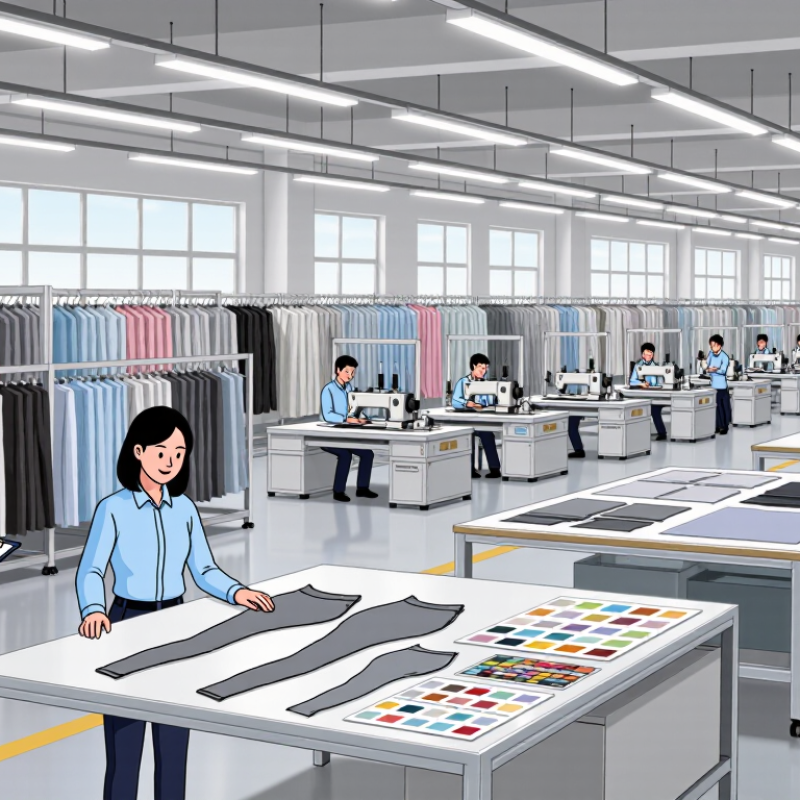
How to Find the Best Fitness Apparel Manufacturer in China

Define Product Scope Against China’s US$293.6B Textile-Apparel Exports in 2023

China’s textile and apparel exports reached US$293.6 billion in 2023, according to China Customs data reported by the China National Textile and Apparel Council. That scale offers buyers many sourcing options, but it does not prove that a factory can make performance wear well. A supplier focused on woven jackets may lack the right equipment or process controls for stretch leggings. Define the product before comparing manufacturers: fabric type, garment construction, size range, target order quantity, and required performance tests.

For activewear, specify details a sample room can verify: fabric composition and weight, stretch and recovery, seam construction, pocket placement, and wash-test expectations. Ask how the factory checks measurements and manages bulk production after sample approval. The export figure describes a national trade category, not a factory’s capacity or quality. That distinction is easy to miss. I would also avoid locking in fabric choices too early; a preferred blend may not suit every climate or price point.

Tips: Send a concise tech pack with reference measurements and clear test requirements. Request a pre-production sample, then compare it with the approved specifications. Keep one unresolved detail? Clarify it before placing the order.

Shortlist Factories by MOQ, Capacity, Lead Time, and OEM/ODM Services

When shortlisting a fitness apparel factory in China, compare its minimum order quantity (MOQ) by style, color, and fabric—not just one headline figure. A low MOQ may apply only to stock fabric, while custom-dyed material can require a larger commitment. Ask for a written breakdown based on your actual size and color mix. Numbers need context.

Check monthly capacity against your forecast, then ask how many sewing lines can make your product and what happens during peak seasons. Request comparable production timelines covering fabric booking, sample approval, cutting, sewing, and inspection. Confirm when the lead-time clock starts; a promise of “30 days” may leave important steps unclear. Ask for proof.

Clarify whether OEM support includes pattern development, grading, fit revisions, and sourcing, or only sewing to your supplied tech pack. ODM may speed development, but review fabric specifications, construction details, and a finished sample before relying on a catalog image. Ask who handles quality checks and how defects are recorded. A comparison sheet helps, but it cannot show how clearly a factory responds when a sample needs revision. That part is easy to underestimate.

Assess Performance Fabrics with AATCC TM195 Moisture-Management Testing

When comparing fitness apparel manufacturers in China, ask how they evaluate moisture management, not just which fabric feels soft. AATCC TM195 measures liquid moisture movement through textiles using a moisture management tester. It records properties such as wetting time, absorption rate, spreading speed, and one-way transport. These results help show how sweat may move across a fabric’s inner and outer surfaces.

Request the test report for the exact fabric you plan to order. Check that it identifies the fiber content, fabric weight, finish, tested side, and sample conditioning. Ask whether the submitted sample matches the bulk-production fabric. It may not. Dyeing, softeners, and other finishing steps can change performance, so testing a finished, production-representative sample is more useful than testing greige fabric alone.

Look at the individual measurements as well as the overall moisture-management rating. A high rating can be informative, but it does not prove a garment will feel comfortable during every workout. Fit, seams, ventilation, and temperature matter too. Request repeat tests when results vary, and compare the data with a simple wear trial.

One detail is easy to miss: a fabric can spread liquid quickly without drying quickly. That distinction deserves a closer look.

Set Quality Checks Using ISO 2859-1 Sampling and AQL 2.5

When evaluating a fitness apparel manufacturer in China, ask how its final inspection uses ISO 2859-1. This standard provides attribute-sampling plans; it does not inspect every garment. AQL 2.5 is a plan parameter, not permission for exactly 2.5% defects in every shipment. Sample size and acceptance numbers depend on lot size, inspection level, and the selected plan. Ask the factory to document those choices before production. Clear records matter.

Define defect categories before inspection. For example, a twisted seam, incorrect garment measurement, or unreadable care label may affect usability or customer expectations. Specify which issues count as major defects and whether AQL 2.5 applies to them. Have the inspector select pieces across cartons, sizes, and colors—not only from one box. Check the seams. Record measurements, photos, sample quantities, and the pass-or-fail result. If a sample fails, agree on containment, rework, and reinspection before shipment. No plan is perfect. Sampling can miss clustered flaws, so discuss that uncertainty openly and review recurring defects after each production run.

How to Find the Best Fitness Apparel Manufacturer in China

Set quality checks using ISO 2859-1 sampling and AQL 2.5.

Example plan: General Inspection Level II, normal single sampling. For each lot-size range, inspect the sample shown. Accept the lot if the number of counted nonconformities is at or below Ac; reject it at or above Re. AQL 2.5 is a sampling-plan index—not a guarantee that every accepted lot contains no more than 2.5% defects. Confirm the applicable plan, defect classification, and switching rules against the ISO 2859-1 edition used in your contract.

Lot size Sample size Ac Re
151–2803223
281–5005034
501–1,2008056
1,201–3,20012578
3,201–10,0002001011

Verify EU REACH and US FTC Rules, Plus CPSIA for Children’s Apparel

When evaluating a fitness apparel manufacturer in China, ask how it checks chemical compliance for each fabric, print, and trim. Under EU REACH, relevant restrictions can apply to substances in textile articles, and duties depend on the product and supply-chain role. Request current test reports that identify the tested material, color, method, and date. A generic certificate may not cover your exact garment.

For US sales, check the Federal Trade Commission’s textile labeling requirements. Labels generally need accurate fiber content, country of origin, and the responsible business identity; care instructions may also be required. Confirm that the factory can keep these details consistent across samples, production labels, and shipping documents. Small discrepancies matter.

Children’s apparel needs extra care. If products are designed primarily for children aged 12 or younger, applicable CPSIA requirements may include limits on lead in accessible components, testing, tracking labels, and a Children’s Product Certificate from the responsible importer or manufacturer. Confirm which rules apply to each item with a qualified compliance professional. Ask for reports from an appropriately accredited lab when required. Real proof beats promises. A tidy folder is reassuring, but it does not prove every colorway or trim was tested. Check the actual records before approving production.