2026 Best Plastic Vacuum Bottle for Wholesale Buyers
Wholesale buyers choosing the 2026 best Plastic Vacuum Bottle need more than a low unit price. They need dependable insulation, consistent finishes, and packaging that arrives intact. A bottle may look polished in a product photo, yet a loose lid or scratched coating can quickly undermine a bulk order.
Grand View Research valued the global reusable water bottle market at USD 9.67 billion in 2023 and projected a 4.3% compound annual growth rate from 2024 to 2030. This broad market estimate signals continued demand for reusable drinkware, but it does not isolate plastic vacuum bottles. Buyers should treat it as market context, not a direct sales forecast. Numbers need context.
For sourcing decisions, request documented insulation test results and sample bottles before confirming production. Check the bottle’s weight, mouth opening, lid seal, and surface finish under everyday handling. Ask suppliers how they control batch consistency and protect products during shipping. A small detail matters: one poorly fitted cap can create complaints across hundreds of units. Compare capacity, customization options, minimum order quantities, and lead times alongside price. No supplier is perfect. This guide evaluates those trade-offs using practical purchasing criteria, while noting where available market data cannot answer product-specific questions.
What a Plastic Vacuum Bottle Is and How Its Insulation Works
2026 Best Plastic Vacuum Bottle for Wholesale Buyers
What a Plastic Vacuum Bottle Is and How Its Insulation Works
A plastic vacuum bottle has an inner container and an outer shell, with a sealed space between them. Air is removed from that space to create a vacuum. With fewer air particles present, heat has less opportunity to move between the bottle walls through conduction and convection. Some designs also use reflective surfaces to reduce heat transfer by radiation.
The plastic body does not create the vacuum insulation by itself. The construction does. That distinction matters.
The lid, neck, and seal still affect performance. Heat can escape around a poorly fitting cap, even when the bottle walls are well insulated. For wholesale evaluation, ask for measured temperature-retention results and the test conditions used. Check capacity, material specifications, and whether the cap seals consistently across samples.
A bottle tested with hot liquid in a controlled room may perform differently during daily use. That part is easy to overlook. It is also worth checking the inner wall and seam for visible defects, since small flaws may point to inconsistent production.
Claims alone are not enough; compare samples under the same practical conditions before placing a large order.
Common Plastic Vacuum Bottle Designs and Materials in 2026
Plastic vacuum bottles in 2026 often combine a plastic exterior with a separate insulated liner. The outer shell may use polypropylene or a durable copolyester, while the vacuum chamber is commonly stainless steel. This construction keeps the bottle lighter to handle and allows color, grip, and shape options. Check a product’s cross-section before comparing it with an all-plastic insulated bottle.
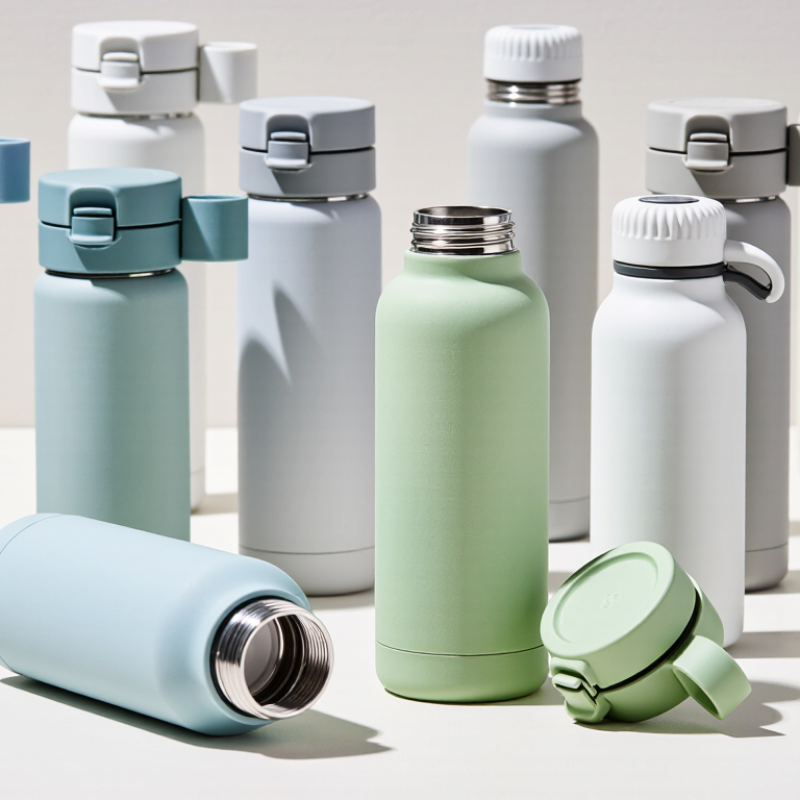
Common designs include straight-sided bottles for easy packing, wide-mouth models for adding ice, and flip-top or straw lids for quick drinking. A removable lid can simplify cleaning, but narrow channels may trap moisture. Small details matter. Check the hinge, gasket fit, and lid threads, especially when ordering samples for wholesale evaluation. A comfortable grip is useful, yet a bulky handle can make cartons less space-efficient.
The term “vacuum bottle” can be confusing. Some plastic bottles use foam insulation rather than a vacuum chamber, so their temperature performance may differ. Ask suppliers for material specifications, insulation details, and test conditions instead of relying on a product label alone. Capacity claims also deserve a practical check: fill a sample with water and measure it. Real use is rarely as neat as a catalog photo.
Key Quality and Safety Standards for Wholesale Bottles
For wholesale buyers, quality starts with the exact materials, not a broad “food-safe” claim. Ask for current test reports covering the bottle body, inner liner, cap, and any gasket. Reports should match the supplied colors and production materials. Requirements vary by destination market, so verify the relevant food-contact rules before placing a large order. Small details matter.
A plastic vacuum bottle should be tested under realistic use conditions. Fill samples with water at the temperatures your customers will use, then check for leaks, odor, deformation, and changes around the cap. Test repeated opening and closing, too. A bottle that passes a visual inspection may still seep after several cycles. Check the seal. Drop tests can reveal weak bases or loose components, but agree on the test method and acceptance limits with the supplier.
Reliable quality control includes clear batch records and inspections during production, not only a final sample. Request traceability for materials and production dates, plus a process for reporting defects. For large orders, inspect samples from more than one carton. One certificate cannot prove that every shipment is consistent; paperwork needs to match real products. This is easy to overlook when deadlines are tight. A lower price may still work, but only if the agreed checks are not quietly reduced.
How Wholesale Buyers Can Compare Suppliers and Product Costs
Wholesale buyers should compare construction before comparing unit prices. Ask whether “vacuum” means a true evacuated chamber or simply foam insulation. Request a cross-section drawing, material breakdown, and hot-water retention test results. A plastic outer shell may hide a stainless-steel liner, which changes both cost and recycling claims. Check cap fit, seal leakage, and surface scratches on production samples.
Compare like with like. Ask each supplier to quote the same capacity, color, print area, packaging, order quantity, and delivery terms. Include tooling, sample fees, inspection, freight, and expected defect rates in the landed cost. One uncomfortable point: the lowest quote can become the expensive choice if lids leak or shipments arrive late. NAPCOR’s 2023 PET Recycling Report puts the U.S. PET bottle recycling rate at 29.1%. If a design uses PET parts, request evidence for recycled-content claims rather than relying on sales language.
Material documentation also matters. The OECD’s 2022 Global Plastics Outlook estimates that 353 million tonnes of plastic waste were generated worldwide in 2019. Just 9% was recycled. That figure covers plastics overall, not vacuum bottles specifically, but it makes clear why material traceability deserves a place in supplier checks. Request resin specifications, batch records, and written test conditions. A tidy sample is not proof of consistent mass production. Compare the documents, then inspect a pre-shipment sample under real handling conditions.
2026 Best Plastic Vacuum Bottle for Wholesale Buyers - How Wholesale Buyers Can Compare Suppliers and Product Costs
| Product option | Typical construction | Capacity | Indicative MOQ | Estimated unit price (USD) | Best suited for | Key points to verify |
|---|---|---|---|---|---|---|
| Compact everyday bottle | Plastic outer shell with vacuum-insulated stainless-steel inner vessel | 350–400 ml | Approx. 500–1,000 pcs | $3.00–$6.00 | Promotional programs, children’s ranges, and short outings | Leak resistance, lid safety, usable capacity, and product dimensions |
| Standard daily-use bottle | Plastic exterior; stainless-steel inner wall; screw or flip-top lid | 500–600 ml | Approx. 500–1,000 pcs | $3.50–$7.00 | Retail, office use, and general-purpose gifting | Inner steel grade, lid seal, coating durability, and insulation test method |
| Large-capacity bottle | Plastic outer body with vacuum-insulated metal liner; larger lid assembly | 750–1,000 ml | Approx. 500–1,000 pcs | $5.00–$9.50 | Outdoor use, sports, and longer trips | Filled weight, grip, cup-holder fit, carton size, and shipping volume |
| Custom-color or printed version | Standard vacuum construction with custom exterior color or logo decoration | Typically 500–750 ml | Often 1,000 pcs or more per color | $4.00–$8.50 | Private-label launches and coordinated product ranges | Color tolerances, print durability, setup fees, and artwork approval process |
| Premium lid or accessory configuration | Vacuum bottle with upgraded carry loop, drinking spout, or interchangeable lid | 500–750 ml | Approx. 1,000 pcs | $5.00–$10.00 | Higher-feature retail lines and gift sets | Spare-part availability, cleaning access, seal replacement, and lid compatibility |
Supplier Comparison Checklist
| Comparison factor | What to request | Why it matters to landed cost |
|---|---|---|
| Like-for-like specification | Capacity, materials, liner details, lid type, finish, and included accessories | Different specifications can make unit-price comparisons misleading. |
| Quantity breaks and MOQ | Prices at several quantities, plus MOQ per model and per color | Color-level minimums and order size affect unit cost and inventory exposure. |
| Customization and tooling | Printing, color matching, mold or tooling charges, setup fees, and repeat-order fees | One-time charges can materially increase the effective cost of a small order. |
| Testing and compliance | Available food-contact documentation, test reports, and applicable market requirements | Testing or documentation costs may be separate; requirements vary by destination market. |
| Packaging and freight | Carton dimensions, units per carton, gross weight, shipping terms, and destination | Freight, duties, and taxes can change the landed cost beyond the quoted product price. |
| Quality control and lead time | Pre-production sample, inspection criteria, defect policy, and production schedule | Clear standards reduce rework, delays, and unexpected replacement costs. |
Choosing Bottle Features for Different Markets and Use Cases
Wholesale buyers should choose bottle features by market, not by color alone. For school programs, a lighter body, rounded edges, and a wide opening make daily filling easier. Details matter. A textured grip helps small hands, while a secure cap can reduce leaks inside crowded backpacks. For outdoor retail, larger capacity and a sturdy carry loop may matter more than a slim profile.
Office and travel buyers often prefer a narrower bottle that fits car cup holders and desk pockets. Check dimensions against actual holders; “standard” sizes vary by vehicle and region. A flip lid supports quick sips, but its hinge adds parts that can wear or trap residue. For family or promotional orders, simple components are often easier to clean and replace.
Ask suppliers to specify the insulation structure, food-contact materials, capacity, and temperature-retention test method. Test it. Some plastic-bodied models use a separate insulated liner, so “vacuum” alone does not prove performance. A sample can look right and still disappoint. Check filled weight, cap sealing, odor after washing, and whether printed artwork survives repeated handling. I would not select a feature just because it sounds premium; test it against how customers will actually use the bottle.