Skip to content

How to Choose the Best Wood Cutting Board Set in 2026?

Choosing the best Wood Cutting Board Set in 2026 requires more than comparing prices and polished product photos. A reliable set should support safe preparation, steady knife work, and practical daily cleaning. Look closely at the wood species, grain direction, board thickness, finish, and edge treatment. Hard maple, walnut, and beech can offer different balances of durability, weight, and appearance. A board that feels stable beneath a chef’s knife is less frustrating than one that slides across the counter.

Small details matter. Check for rubber feet, juice grooves, handles, and separate boards for raw proteins and ready-to-eat foods. These features can improve organization, but they may also complicate cleaning. A deep groove can trap moisture. Decorative handles can collect residue. No board is perfect.

I have learned that surface feel reveals problems quickly. Rough patches catch a cloth, while excessive oil leaves a sticky sheen. A quality set should arrive smooth, evenly finished, and free from strong chemical odors. Buyers should also review care instructions, manufacturer transparency, warranty terms, and credible testing information. Personal experience is useful, but it should not replace evidence from reputable woodworking or food-safety sources. Hand-washing, prompt drying, and regular conditioning usually extend a board’s service life. Even so, maintenance takes discipline, and many attractive sets fail because owners forget that step. This guide examines the practical choices behind a dependable set, helping you compare performance, hygiene, design, and long-term value with a more critical eye.
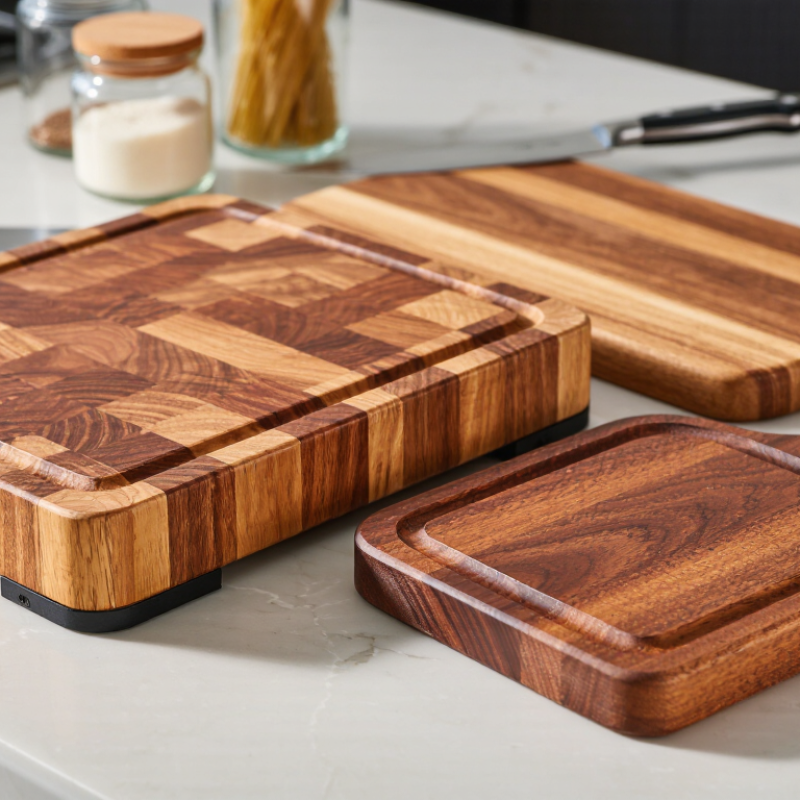
How to Choose the Best Wood Cutting Board Set in 2026?

Classify Cutting Tasks Using USDA’s 165°F, 160°F, and 145°F Targets

How to Choose the Best Wood Cutting Board Set in 2026?

A useful wood cutting board set should match cooking tasks, not just kitchen décor. USDA FSIS lists 165°F for poultry, 160°F for ground meats, and 145°F for whole cuts of beef, pork, lamb, and veal, followed by a three-minute rest. These temperatures classify risk before cooking.

Use one board for raw poultry, another for ground meat, and a third for vegetables or cooked foods.

A board with clear size differences can prevent hurried mistakes.

Tips: Keep the poultry board closest to the sink. Choose thick boards that resist movement and have smooth, cleanable surfaces. Dry each board upright, especially after washing. Replace boards with deep grooves that trap residue.

FDA Food Code 2022 emphasizes preventing cross-contamination through separation, cleaning, and sanitizing food-contact surfaces. Wood needs careful maintenance, not blind confidence.

In daily use, raw chicken juice can reach a board handle or countertop within seconds. I still make mistakes when cooking several dishes at once. That is why I prefer simple visual rules over memory.

A small board for garlic and herbs reduces contact with meat areas. A larger board gives vegetables room to stay away from raw juices.

USDA temperature targets protect the final food, but board separation protects the steps before cooking. Temperature checks remain essential; appearance alone is unreliable.

Compare Wood Species by Janka Hardness, Grain, and Moisture Data

How to Choose the Best Wood Cutting Board Set in 2026?

Compare Wood Species by Janka Hardness, Grain, and Moisture Data

When I compare cutting boards, I start with Janka hardness, not appearance. Hard maple measures about 1,450 lbf, while walnut averages near 1,010 lbf. Beech often reaches 1,300 lbf, and cherry stays around 950 lbf. These figures vary by growth conditions and testing methods. A harder board resists knife marks, but it may feel less forgiving during long chopping sessions.

Grain direction matters just as much. End-grain boards expose short wood fibers, which can close slightly after knife contact. Edge-grain boards usually cost less and feel lighter. Face-grain boards show attractive patterns, but they may scar sooner. I prefer a stable edge-grain board for daily vegetables. For heavy cleaving, neither design should replace a proper chopping block.

Moisture content can quietly decide whether a set stays flat. Indoor boards often perform well around 8–12% moisture content, though local humidity changes that range. Check for cupping, raised seams, or a sharp dry feel along the edges. A moisture meter adds useful evidence, but it is not perfect. I once trusted a smooth surface too quickly and missed a slight twist underneath. That mistake changed my buying habit. I now inspect the underside, compare board weight, and ask how the wood was dried. A beautiful board can still fail when moisture moves unevenly.

Match Board Sizes to USDA Separation and Kitchen Workflow Guidance

How to Choose the Best Wood Cutting Board Set in 2026?

A useful wood cutting board set should match USDA food separation guidance and your actual kitchen routine. Keep one board for raw meat, poultry, and seafood. Use another for vegetables, fruit, bread, and cooked foods. This reduces cross-contamination during busy meal preparation. Size matters, too. A large board gives vegetables room to spread without falling onto the counter. A medium board suits raw proteins and fits more easily beside the sink. A small board works well for herbs, garlic, or quick garnishes.

In my kitchen, I prefer a large produce board near the knife block and a separate medium protein board near the cooking area. The workflow feels smoother. It also limits unnecessary movement while handling raw ingredients. USDA guidance recommends washing boards with hot, soapy water after use. Sanitize them when appropriate, especially after raw proteins. Dry the wood upright, not flat against a damp counter. Never use a board with deep cracks, stubborn odors, or grooves that hold residue. Replace it when cleaning no longer feels reliable.

I once bought boards that looked attractive but were too small for meal prep. That choice created spills and rushed cleaning. Bigger is not always better, though. A board must fit your sink, storage space, and counter. Check its weight and stability before buying. Some wood surfaces need regular conditioning, and I sometimes forget. That is an honest weakness in my routine. A set only protects food when its care matches your habits.

How to Choose the Best Wood Cutting Board Set in 2026? - Match Board Sizes to USDA Separation and Kitchen Workflow Guidance

Board Role Recommended Size
(L × W)
Approx. Surface Area Suggested Thickness Best Kitchen Workflow Separation Purpose Practical Selection Notes
Large raw-protein board 18 × 12 in
(46 × 30 cm)
216 sq in
(1,394 cm²)
1–1.25 in
(2.5–3.2 cm)
Breaking down poultry, trimming meat, or portioning fish before cooking. Keep raw meat, poultry, and seafood tasks separate from ready-to-eat foods. Choose a stable board with enough room to keep raw juices away from the counter edge. Use only if it fits securely in the sink or dishwasher-free cleaning area.
Medium produce board 15 × 10 in
(38 × 25 cm)
150 sq in
(968 cm²)
0.75–1 in
(1.9–2.5 cm)
Daily chopping of vegetables, herbs, fruit, and ingredients for cooked dishes. Provides a dedicated surface for produce and other foods that may be eaten without further cooking. A medium board balances workspace and storage. Keep it visibly or physically distinct from the raw-protein board.
Small ready-to-eat board 12 × 8 in
(30 × 20 cm)
96 sq in
(619 cm²)
0.5–0.75 in
(1.3–1.9 cm)
Slicing cooked meat, cheese, bread, garnishes, or fruit for serving. Reduces the chance that cooked or ready-to-eat food contacts a surface used for raw ingredients. Useful for small kitchens and final plating. Do not use it for raw meat unless it is thoroughly cleaned and sanitized afterward.
Bread and pastry board 16 × 10 in
(41 × 25 cm)
160 sq in
(1,032 cm²)
0.75–1 in
(1.9–2.5 cm)
Slicing loaves, rolls, pastries, and dry baked goods. Keeps crumbs and flour away from raw-protein preparation and helps protect ready-to-eat foods. A grooved design can collect crumbs, but deep grooves are harder to clean. Use a smooth, food-contact-safe surface for easier maintenance.
Compact prep board 12 × 9 in
(30 × 23 cm)
108 sq in
(697 cm²)
0.5–0.75 in
(1.3–1.9 cm)
Quick preparation of one or two ingredients, especially in apartments or small kitchens. Can be assigned to produce or ready-to-eat foods so the larger boards remain available for main tasks. Select non-slip feet or a damp towel under the board. A board that moves during cutting is less safe, regardless of material.
Carving and serving board 18 × 14 in
(46 × 36 cm)
252 sq in
(1,626 cm²)
1–1.5 in
(2.5–3.8 cm)
Resting and slicing cooked roasts, poultry, or large vegetables after cooking. Supports separation between cooked food and the board used for raw preparation. A perimeter groove may collect meat juices. Wash the board before using it for another food category.
Flexible-use spare board 14 × 10 in
(36 × 25 cm)
140 sq in
(903 cm²)
0.5–0.75 in
(1.3–1.9 cm)
Backup preparation during batch cooking or when the primary board is being washed. Allows a clean board to be used while another board is reserved for raw ingredients or awaiting cleaning. Assign the board to one food category at a time. Avoid switching roles mid-preparation without washing, rinsing, and sanitizing.
Small household starter set 12 × 8 in
15 × 10 in
18 × 12 in
96–216 sq in
(619–1,394 cm²)
0.5–1.25 in
(1.3–3.2 cm)
A practical three-board sequence for small households and everyday meal preparation. Assign one board to raw proteins, one to produce, and one to cooked or ready-to-eat foods. This arrangement follows the principle of separating raw animal foods from foods that will not receive additional cooking.
Food-safety note: The USDA advises using separate cutting boards for raw meat, poultry, and seafood and for produce, bread, or other ready-to-eat foods. If one board is used for multiple categories, wash it with hot, soapy water after each use and sanitize it before preparing ready-to-eat food. Replace wooden boards when they become excessively worn or develop hard-to-clean grooves or cracks. The dimensions above are practical kitchen recommendations, not USDA-mandated sizes.

Assess Construction Against NSF/ANSI 2 Food-Equipment Standards

How to Choose the Best Wood Cutting Board Set in 2026?

When selecting a wood cutting board set, examine construction against NSF/ANSI 2 food-equipment principles. This standard emphasizes food-contact surfaces that are durable, cleanable, and made from suitable materials. It does not automatically certify every wooden board. Verify any certification claim through reliable documentation.

Look closely at the board’s surface, edges, and joints. The wood should feel smooth, without deep knife grooves, open cracks, or loose sections. Tight grain can reduce trapped food particles, while stable construction helps prevent warping. Avoid decorative gaps that collect moisture. I once preferred a heavier board, but weight alone did not prevent movement during chopping. Non-slip feet or a stable base may matter more.

Tips: Wash according to the care instructions, dry the board upright, and inspect it after every deep cleaning. Choose surfaces that are easy to reach and scrub. Handles should not create hidden crevices. Replace a board when cracks become difficult to clean. A food-safe finish helps, but it cannot repair damaged wood. Separate boards for different foods can also reduce cross-contact, although storage space becomes a practical concern. Cleanability is the real test.

Rank 2026 Sets by Usable Area, Set Count, Price, and Replacement Cost

In 2026, the best wood cutting board set is not automatically the largest. I compare four numbers before buying: usable area, set count, purchase price, and replacement cost. Usable area means the flat cutting surface, not the carved juice groove or rounded edge. A 16-by-12-inch board offers 192 square inches, but the practical space is smaller. Measure it.

Set count matters only when each piece has a clear job. A two-board set may separate vegetables from raw proteins. A three-board set can add bread or serving duties, but unused boards consume storage space. I rank sets by useful pieces, not packaging claims. Check thickness, too. A thick board feels stable and can survive repeated sanding, while a thin board may warp near a wet sink. My experience favors boards that dry upright overnight.

Price needs a second calculation. Divide the purchase price by usable area, then estimate replacement cost over several years. A cheap board that splits after one season is not cheap. Replacement cost includes a new board, shipping, and sometimes lost time. Still, predictions are imperfect. Cooking frequency and washing habits change everything. I would choose a moderately priced set with individually replaceable boards rather than discard the whole set after one deep crack. Apply food-safe mineral oil regularly, but even careful maintenance cannot prevent every failure.

How to Choose the Best Wood Cutting Board Set in 2026?

2026 comparison of anonymized wood cutting board sets by usable area, set count, purchase price, and estimated replacement cost.

The chart uses a normalized 0–100 comparison index so different units can be viewed together. A higher score indicates more usable cutting area or more boards, while price and replacement-cost scores favor lower costs. Hover over each bar to see the underlying figures.