Skip to content

Top Charcuterie Board Set Manufacturers in China

A Charcuterie Board Set is more than a serving surface. It brings together wood, ceramic bowls, knives, and small details that shape how food looks and feels at the table. For buyers exploring Chinese manufacturers, the challenge is finding a supplier that can deliver consistent materials, careful finishing, and reliable customization—not just an attractive product photo.

The category also sits within a large food culture. The USDA’s Dairy Products report records U.S. cheese production at roughly 13.8 billion pounds in 2023, a useful indicator of the scale of cheese consumption, though not a direct measure of charcuterie board sales. Cheese writer Clifton Fadiman captured the ingredient’s appeal in the familiar line, “Cheese is milk’s leap toward immortality.” A good board gives that ingredient room to shine. Small details matter: a smooth edge, stable feet, bowls that sit securely, and knives that feel balanced in the hand.

This guide to Top Charcuterie Board Set Manufacturers in China will help readers compare product capabilities, materials, customization options, and quality-control practices. A polished finish matters. So does the less visible work: checking wood consistency, testing assembly, and confirming packaging protects each piece in transit. Supplier claims should be verified with samples and clear specifications. Not every catalog tells the full story. The goal is to identify manufacturers that combine attractive design with dependable production, while recognizing that sourcing decisions still require careful review.
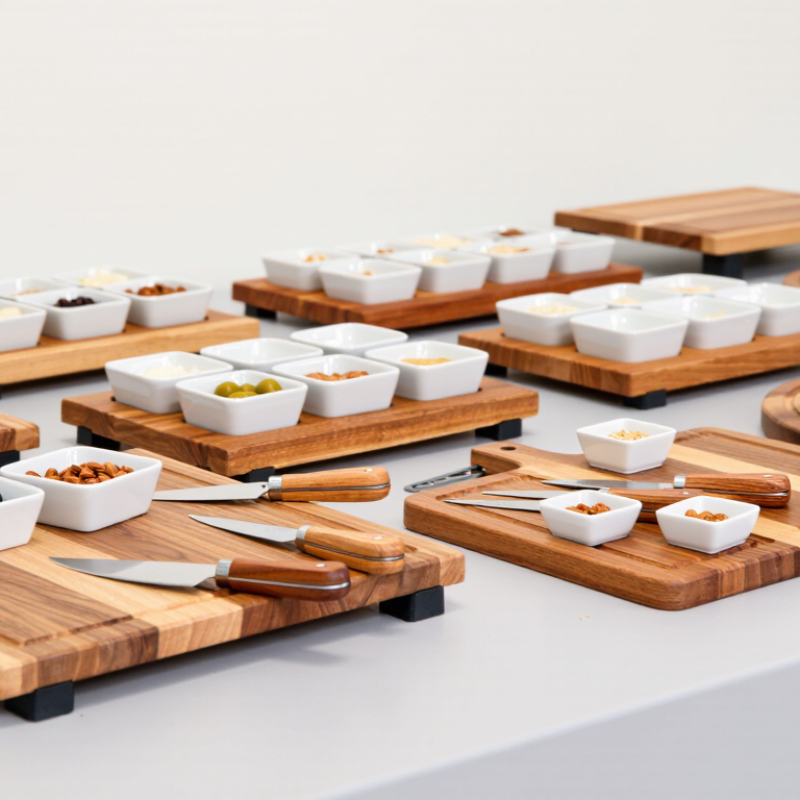
Top Charcuterie Board Set Manufacturers in China

Charcuterie Board Sets: Materials, Components, and Common Product Types

Charcuterie board sets combine a serving surface with tools for arranging cheeses, fruit, cured meats, and small snacks. Wood remains popular for its warm appearance and sturdy feel. Acacia, bamboo, and rubberwood are common choices, while marble and slate offer cool, smooth surfaces. Each material behaves differently. Wood needs gentle cleaning and thorough drying; stone can feel heavy and may chip at the edges. Sets may include cheese knives, forks, ceramic bowls, slate labels, or a built-in groove for crackers.

Common designs include rectangular boards, round platters, handled paddles, and rotating boards for shared tables. Some sets add a concealed drawer for utensils, while compact versions pair a board with small dipping bowls. When evaluating products from Chinese manufacturers, check the board’s thickness, surface finish, accessory fit, and packaging protection. A smooth finish matters, but it should not hide uneven joints or rough edges. Details can be missed. Even a well-presented set may need better care instructions or more secure utensil storage.

Tips: Ask how the wood is dried and finished, and request close-up photos of corners and fittings. Check that knives sit securely and bowls do not wobble. Match the board size to typical portions and storage space; larger is not always more useful.

China’s Wood and Bamboo Boards Under GB 4806.12-2022

Top Charcuterie Board Set Manufacturers in China
China’s Wood and Bamboo Boards Under GB 4806.12-2022

For Chinese manufacturers, food-contact safety starts with material control, not polished product photos. GB 4806.12-2022 sets national food-safety requirements for bamboo and wood materials and products intended for food contact. It addresses raw materials, sensory properties, and specified physicochemical indicators. Buyers should request test reports for the actual board construction, including its finish and any adhesive. A report for untreated wood may not represent a coated board.

Details matter. Charcuterie boards meet cheese oils, fruit juices, and knife marks; surface wear can change real-world exposure. FAO’s Global Forest Products Facts and Figures 2022 reports 399 million cubic metres of global wood-based panel production that year. That scale illustrates a broad materials supply chain, but it does not prove food-contact compliance.

Not a proxy.

A practical supplier review should trace wood or bamboo species, processing aids, coatings, and batch records. Ask how samples were prepared for testing and whether the report identifies the tested product. Also check that instructions cover washing and drying; prolonged soaking can damage boards. One point deserves scrutiny: a compliant test result is useful evidence, not a guarantee that every production batch behaves identically. Good sourcing leaves room for verification.

How to Compare Manufacturers: Production Capacity, QC, and Export Data

Comparing Chinese charcuterie board set manufacturers starts with measurable capacity, not a polished catalog. Ask for monthly output by material and set configuration, then check whether that figure matches recent production records. A factory making 20,000 boards monthly may still struggle when handles, knives, packaging, and engraving enter the same order. Request a sample schedule, peak-season lead times, and the number of active production lines. Small details matter: board thickness checks, moisture readings, and edge-sanding standards should appear in written inspection records. “We inspect every order” is not a useful metric without inspection frequency and defect thresholds.

Quality systems need evidence. ISO’s Survey of Management System Standard Certifications reports ISO 9001 certificates by country, but certification alone does not reveal a supplier’s actual defect rate. Ask for recent inspection reports, corrective-action examples, and pre-shipment sampling results. The numbers may be imperfect; that is worth discussing. A supplier that explains a failed batch and its remedy can be more credible than one offering only spotless claims.

For export history, request redacted bills of lading, packing lists, or customs records that match the product type and shipment dates. UN Comtrade classifies wooden tableware and kitchenware under HS 4419, but this category does not isolate charcuterie board sets. Compare like with like. The World Bank’s 2023 Logistics Performance Index ranked China 19th, a useful country-level benchmark, not proof of any factory’s shipping performance. Check the manufacturer’s own on-time shipment rate, destination experience, and packaging test results for your route.

Top Charcuterie Board Set Manufacturers in China: Comparing QC

ISO 2859-1 sampling example: sample sizes for selected lot-size ranges under General Inspection Level II.

For example, a lot of 501–1,200 units uses a sample of 80; a lot of 3,201–10,000 units uses a sample of 200. These are standard sampling-plan figures, not manufacturer performance data. AQL and acceptance criteria must also be specified. Compare suppliers’ documented monthly capacity and export history separately.

Source: ISO 2859-1, Table 1, General Inspection Level II. Lot-size ranges and sample sizes shown are selected entries.

Leading Chinese Makers: Product Ranges, Materials, and Customization

Chinese manufacturers produce charcuterie board sets in formats ranging from compact, single-board kits to larger serving collections with knives, bowls, and serving utensils. Common board materials include acacia, bamboo, rubberwood, and walnut, each with a different grain, weight, and maintenance profile. Some sets add slate inserts or ceramic dishes for olives and dips. Small details matter: a shallow juice groove can catch moisture, while a recessed handle makes a board easier to lift from a crowded table.

Customization often covers board dimensions, wood species, surface finish, packaging, and utensil combinations. Buyers can request logo engraving or private-label boxes, but specifications should be confirmed with drawings and a physical sample. Ask about wood sourcing, food-contact finishes, edge sanding, and inspection procedures. These checks make comparisons more practical than catalog photos alone. A sample can reveal rough corners or uneven color that images hide.

Large orders may allow more design flexibility, while smaller runs can have fewer choices or higher unit costs. Discuss tolerances early, especially for engraved details and fitted accessories. A perfect finish is not always realistic across natural wood; visible grain variation is part of the material, though inconsistent sanding is a separate issue. Confirm how suppliers handle both.

Top Charcuterie Board Set Manufacturers in China – Leading Chinese Makers: Product Ranges, Materials, and Customization
Manufacturing Focus Typical Product Range Common Materials Customization Options Practical Considerations
Solid-wood board production Serving boards, carving boards, paddle boards, and board-and-knife gift sets Acacia, beech, bamboo, and other hardwoods suitable for food-contact products Board dimensions, handle shape, edge profile, juice groove, engraved design, and gift packaging Wood grain and color vary naturally. Care instructions commonly advise hand washing and prompt drying.
Bamboo kitchenware production Lightweight serving boards, multi-piece board sets, and compact appetizer trays Laminated bamboo and bamboo-based composites made for kitchenware Panel size, rounded corners, surface finish, logo engraving, and bundled utensils Bamboo is lightweight and has a distinctive grain pattern. Construction and finish should be checked for the intended food-contact use.
Board-and-accessory set assembly Boards paired with cheese knives, spreaders, bowls, slate inserts, or serving utensils Wood or bamboo boards combined with stainless-steel utensils, ceramic bowls, or slate components Accessory selection, set configuration, insert layout, presentation box, and printed inserts Set contents and materials can differ by specification. Confirm utensil material, dimensions, and packaging requirements before ordering.
Large-format and entertaining boards Wide serving boards, table-centerpiece boards, and multi-section presentation boards Solid wood, bamboo panels, or combinations of wood with removable serving components Overall dimensions, compartment layout, handles, feet, juice channels, and surface engraving Large boards need suitable storage and may be heavier. Finished dimensions and tolerances should be agreed in the product specification.
Private-label and gift-set manufacturing Retail-ready board sets for homeware, food gifting, and promotional programs Material selection based on the board design, accessory list, and packaging brief Custom artwork, packaging format, color printing, set contents, and product inserts Artwork approval, packaging tests, order quantity, lead time, and applicable market requirements should be confirmed with the supplier.
Finish and detailing services Boards with shaped edges, routed grooves, hanging holes, or decorative surface details Food-contact-suitable wood finishes specified for the intended use; unfinished options may also be available Oil or coating specification, edge rounding, laser engraving, and surface texture Ask for the finish specification and care guidance. Avoid assuming that every coating or decorative treatment is suitable for direct food contact.

Buyer Checks: Food-Contact Test Reports, MOQ, and Lead Time

When comparing top charcuterie board set manufacturers in China, request food-contact evidence for the exact wood, finish, and production site. For wood and bamboo products, ask whether testing covers China’s GB 4806.12-2022 standard; confirm destination-market requirements separately. The report should identify the tested sample, methods, results, and issuing laboratory. Check that the lab’s ISO/IEC 17025 accreditation covers the relevant tests. A polished PDF alone proves little. ISO’s 2023 Survey of Management System Standard Certifications records more than one million ISO 9001 certificates in China, but quality-system certification does not replace product testing.

MOQ needs a written breakdown. Ask for quantities by board size, wood species, finish, engraving, and gift-box option. A low MOQ may apply only to standard designs, while custom packaging can raise the threshold. Compare landed unit cost at two or three order volumes, not just the sample price. Lead time should separate sample approval, material preparation, production, inspection, and shipping. Request dates, not vague promises like “fast delivery.” Allow extra time if the factory must source a new finish or packaging insert.

Tips: Send a dated, signed sample specification, then require the final batch to match it. Confirm whether the quoted lead time starts after deposit or artwork approval. Small detail, big impact. I would also ask for recent batch test records; a report from an older or different product may not reflect the boards you will receive.