How to Choose the Right Tote Shuttle for Global Sourcing?
Choosing the right Tote Shuttle for global sourcing is not simply a matter of selecting the fastest machine. It requires a careful match between warehouse conditions, inventory behavior, supplier capabilities, and future growth. A system that performs well in a small European facility may struggle in a humid Asian warehouse with different carton sizes, labor patterns, or maintenance access. Every detail matters. Even aisle width.
Mick Mountz, founder of Kiva Systems and a recognized warehouse automation pioneer, once said, “The goal is to eliminate walking.” His observation remains relevant when evaluating a Tote Shuttle. Reduced travel can improve storage density, order speed, and worker ergonomics. However, speed alone can create hidden weaknesses. Buyers should examine shuttle acceleration, tote compatibility, lift capacity, software integration, battery strategy, safety functions, and local service support. A lower purchase price may become expensive if spare parts require long international shipping.
Practical experience also shows that product data is often incomplete. Published throughput may reflect ideal conditions, not peak-season pressure or mixed-order complexity. Request a site-specific simulation. Test real totes, real SKU profiles, and realistic replenishment patterns. Ask suppliers to explain recovery procedures after a jam or network failure. The best Tote Shuttle is rarely the most impressive model on paper. It is the one that remains stable, maintainable, and commercially sensible across borders. That choice demands evidence, not optimism.
Define Tote Shuttle Types and Their Operating Principles
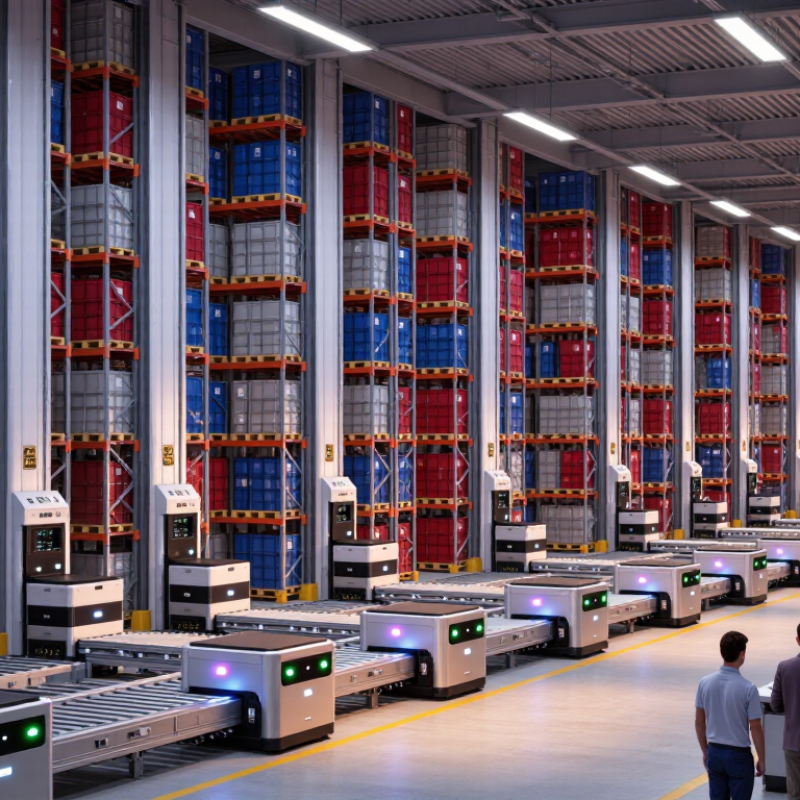
Choosing a tote shuttle for global sourcing starts with definitions, not catalog capacity. A tote shuttle is an automated storage and retrieval system where powered carts move totes along storage rails. A lift changes levels, while conveyors connect storage with picking or replenishment stations. That is the basic operating principle. The 2024 World Robotics report recorded 541,302 industrial robots installed worldwide in 2023. This is not a tote-shuttle forecast, but it shows the broader automation trend. MHI’s 2024 Annual Industry Report also identifies robotics and automation as major supply-chain investment priorities.
For procurement, classify shuttle types by movement. In a fixed-level system, each storage tier has a dedicated shuttle, and a lift transfers totes vertically. It delivers predictable access and strong performance on busy levels. A multi-level or three-dimensional shuttle can move between tiers, reducing duplicated equipment. It may also create more complex controls and maintenance points. Single-deep storage favors direct access. Multi-deep storage improves density but requires careful sequencing when older stock must be retrieved first.
The right choice depends on tote size, load weight, order profile, and station distance. Measure real peaks, not average hourly demand. Check barcode rules, WMS and WCS interfaces, emergency access, spare parts, and local service skills. A 600-by-400-millimeter tote may fit physically, yet fail when dividers reduce usable volume. A neat throughput spreadsheet can still lie. MHI’s findings support automation investment, but each site needs a controlled pilot, realistic replenishment tests, and human review of failure recovery. Perfect assumptions are rare.
Assess Load Requirements and Tote Compatibility
Choosing a tote shuttle starts with the load, not the shuttle’s advertised speed. Record each tote’s length, width, height, tare weight, payload, and center of gravity. Include the heaviest realistic case.
A practical test should use full totes, damaged corners, and unevenly packed goods. Measure acceleration, stopping distance, and tote movement. A spreadsheet can still mislead. MHI’s 2024 Annual Industry Report states that 55% of supply chain professionals planned to increase technology and innovation investment. That investment deserves accurate input data, not optimistic estimates.
Compatibility is equally important. Check the tote base, rim strength, side-wall clearance, and nesting features. Confirm that the shuttle’s load carriers support the tote without scraping labels or catching handles. Test standard and supplier-specific dimensions together. A two-millimeter mismatch may seem harmless, but repeated impacts can create jams and product damage. Verify barcode visibility, sensor response, and access for maintenance teams.
Keep the operating environment in the test plan. Dust, cold storage, moisture, and temperature changes can alter plastic dimensions and belt traction. For global sourcing, compare tote samples from every approved supplier. Material variation is easy to overlook. Use a safety margin above the calculated payload, but avoid excessive capacity that wastes energy and rack space. A pilot with real totes, real cycle rates, and deliberately imperfect packing will reveal more than a brochure.
How to Choose the Right Tote Shuttle for Global Sourcing? - Assess Load Requirements and Tote Compatibility
| Assessment Dimension | Typical Requirement | Recommended Tote Shuttle Specification | Compatibility Check | Sourcing Decision Guide |
|---|---|---|---|---|
| Load per tote | Up to 35 kg, including the tote and contents | Select a shuttle with a rated payload of at least 40–50 kg to provide a practical safety margin. | Confirm the rated payload applies to the full tote footprint and the intended rack height. | Avoid selecting equipment at its maximum rated capacity for continuous operation. |
| Light-duty order picking | Small items, apparel, electronics accessories, or pharmaceutical packages; usually 5–15 kg per tote | A compact tote shuttle with smooth acceleration and adjustable location control is generally suitable. | Verify that the tote base is rigid enough for repeated handling and does not flex into the conveyor or shuttle interface. | Prioritize throughput, quiet operation, and accurate tote positioning over maximum payload. |
| Medium-duty storage | General merchandise or components weighing 15–30 kg per tote | Use a shuttle designed for continuous cycling at the required payload, with reinforced load-transfer components. | Check tote deflection, rack clearances, shuttle fork or platform dimensions, and transfer height. | Request test results based on the actual tote and load combination rather than an empty-tote demonstration. |
| Heavy-duty tote handling | Loads above 30 kg or dense products with concentrated weight | Choose a heavy-load shuttle with a higher payload rating, reinforced chassis, and suitable braking capacity. | Confirm that the tote bottom, runners, and rack beams can support concentrated loads without permanent deformation. | Include dynamic forces during acceleration, stopping, loading, and emergency recovery in the capacity review. |
| Common tote footprint | Standard footprint families such as 300 × 400 mm, 400 × 600 mm, or 600 × 800 mm | Select a shuttle and rack channel sized for the tote footprint, including side and longitudinal clearance. | Measure the actual external dimensions, including molded ribs, handles, labels, lids, and protruding features. | Do not rely only on nominal tote dimensions supplied in a catalog. |
| Tote height | Approximately 120–400 mm, depending on product size and storage density | Use shuttle controls and rack spacing that accommodate the tallest tote, lid, and allowable load profile. | Check vertical clearance at entry points, transfer stations, sensors, and the upper rack beam. | Allow additional clearance for tote variation, product overhang, and maintenance access. |
| Tote base design | Flat base, ribbed base, molded runners, or feet | Match the shuttle contact surface and rack rails to the tote base geometry. | Inspect for snag points, unsupported ribs, excessive friction, and unstable contact during movement. | Require loaded-tote trials with new, worn, and slightly deformed containers. |
| Throughput demand | Low: under 30 tote movements/hour; medium: 30–80; high: over 80 | Size the number of shuttles, lifts, conveyors, and workstations as one integrated system. | Confirm cycle time using the real travel distance, rack depth, acceleration profile, and handover sequence. | Use peak-hour demand and order-batch patterns, not only daily average volume. |
| Storage depth | Single-deep, double-deep, or multi-deep tote channels | Select a shuttle travel length and positioning method that reaches the deepest storage location safely. | Verify channel straightness, stop accuracy, tote retrieval clearance, and access to blocked locations. | Multi-deep storage improves density but may reduce direct access and increase sequencing requirements. |
| Temperature and environment | Ambient warehouse, chilled area, cold storage, dust, or elevated humidity | Specify suitable materials, lubrication, batteries, sensors, seals, and control components for the operating environment. | Confirm operating temperature range, condensation controls, corrosion resistance, and charging requirements. | Obtain environmental test documentation before approving the equipment for non-ambient areas. |
| Container variation | Multiple tote sizes, suppliers, materials, or levels of wear | Use adjustable guides, barcode or RFID identification, and software rules for tote-type recognition where necessary. | Test the smallest, largest, heaviest, lightest, oldest, and most flexible tote in the proposed fleet. | Standardizing tote dimensions generally simplifies control logic and improves operational reliability. |
| Integration requirements | Warehouse control, inventory management, conveyors, lifts, picking stations, and safety systems | Specify open communication interfaces, status feedback, fault reporting, and recovery procedures. | Confirm data exchange, tote tracking, emergency-stop behavior, and manual recovery access. | Require a complete interface list and acceptance test plan before purchase approval. |
Compare Shuttle Performance, Capacity, and Storage Density
How to Choose the Right Tote Shuttle for Global Sourcing?
A tote shuttle should be judged by performance, capacity, and storage density. These factors directly affect picking speed, labor use, and warehouse expansion plans. During warehouse evaluations, I compare actual tote retrieval time, not only advertised cycle rates. Measure average movement, waiting time, and recovery after a missed tote. A fast shuttle still underperforms when software delays the next task.
Capacity needs careful calculation. Review tote dimensions, load weight, order profiles, and daily peak volume. A system designed for small components may struggle with heavier cartons or irregular inventory.
Storage density also matters. Count usable tote locations per square meter, including service aisles, lifts, and maintenance access. Very dense storage can reduce travel distance, but it may restrict inspection and future changes.
I once favored maximum density and underestimated access time. That decision looked efficient on paper, but daily replenishment became slower.
Test with real totes and mixed inventory. Record ten repeated cycles. Compare results during peak hours. Leave space for maintenance. Ask operators what feels difficult. Their feedback often reveals problems that a spreadsheet misses. Also check energy use, noise, safety controls, and integration with warehouse software. Performance should remain stable as product variety increases. A practical design is rarely the most compact design.
Evaluate Integration, Safety, Maintenance, and Scalability
Choosing the right tote shuttle starts with integration, not speed. Confirm compatibility with your WMS, WCS, conveyors, scanners, and existing storage dimensions. Request interface documentation before signing a purchase agreement. Data should move reliably, with clear alarms and traceable tote locations. Integration testing should use real order profiles, including peak periods and damaged labels.
Safety requires more than emergency-stop buttons. Ask for guarded access points, safe maintenance zones, sensor redundancy, and documented risk assessments. Operators should understand recovery procedures without entering hazardous areas. The system should follow applicable local safety standards. A fast shuttle is not valuable if one unclear alarm stops the entire aisle.
Maintenance and scalability deserve equal attention. Check access to motors, sensors, belts, and charging components. Preventive maintenance intervals should be practical for your team and operating hours. Keep critical spare parts locally when possible. Consider modular lanes, software capacity, and future tote-size changes. A system that performs well today may become restrictive after expansion. That is an easy mistake to miss.
Tips: Test integration with actual data. Measure recovery time, not only throughput. Inspect service access during a live demonstration. Ask for training records, maintenance manuals, and upgrade costs. Leave room for honest uncertainty; projected volumes often change.
Select the Best Tote Shuttle for Global Sourcing Operations
Selecting the best tote shuttle for global sourcing operations starts with inventory, not machinery. A 600 mm tote carrying metal fittings needs different handling from one holding fragile electronics. Measure tote dimensions, payload, SKU velocity, replenishment waves, and storage temperatures. Then test peak-hour demand, not average demand. Peak demand exposes weak designs.
MHI’s 2024 Annual Industry Report found that 58% of respondents planned to adopt robotics and automation within five years. This supports shuttle investment, but automation alone cannot fix poor master data. Check aisle density, lift height, tote presentation, and picking ergonomics. Request simulations using real order profiles. Ask for recovery procedures when one shuttle, sensor, or conveyor fails. Small delays multiply across international fulfillment networks.
Global sourcing also requires service resilience. Select controls that support common data interfaces, remote diagnostics, and local maintenance training. DHL’s Logistics Trend Radar 7.0 identifies AI, robotics, and resilient supply chains as important logistics trends. However, connectivity is not automatically reliability. A practical trial should include dusty totes, mixed loads, replenishment errors, and power interruptions. Perfect forecasting is impossible. Leave capacity for seasonal surges and new suppliers. This is where many projects become overconfident. Compare energy use per tote, spare-part availability, safety validation, and operator learning time before approving the final configuration.