Skip to content

7 Tips for Choosing Stainless Non Stick Cookware

Stainless Non Stick Cookware promises two useful qualities: a durable-looking steel body and easier food release. Yet the label alone tells you little. Some pans pair stainless steel with a nonstick-coated cooking surface; others use different layered constructions. Check the product details before comparing prices. “Materials are the stuff of our lives,” writes materials scientist Dr. Mark Miodownik, a helpful reminder that a pan’s materials affect everyday use. His work is broader than cookware, so the buying details still deserve close attention.

A good choice starts with your stove, cooking habits, and care routine. Look for clear information about the pan’s base, coating, oven limits, and dishwasher guidance. Hold the handle if you can. A heavy pan may feel reassuring in a shop, then awkward when full of pasta. Small details matter. A flat, stable base can help on a smooth cooktop, while a comfortable grip makes frequent use easier. A shiny finish is tempting, but it cannot tell you how evenly a pan heats or how long its coating will last.

These seven tips will help you assess construction, heat performance, coating, handles, lids, cleaning, and warranty terms. They are practical checks, not guarantees. Cooking temperature, utensils, and care can affect a pan’s performance over time. I would not choose by brand name alone; even a well-reviewed pan may not suit your kitchen. Compare the maker’s care instructions with your routine, and favor specific, readable product information over vague claims.
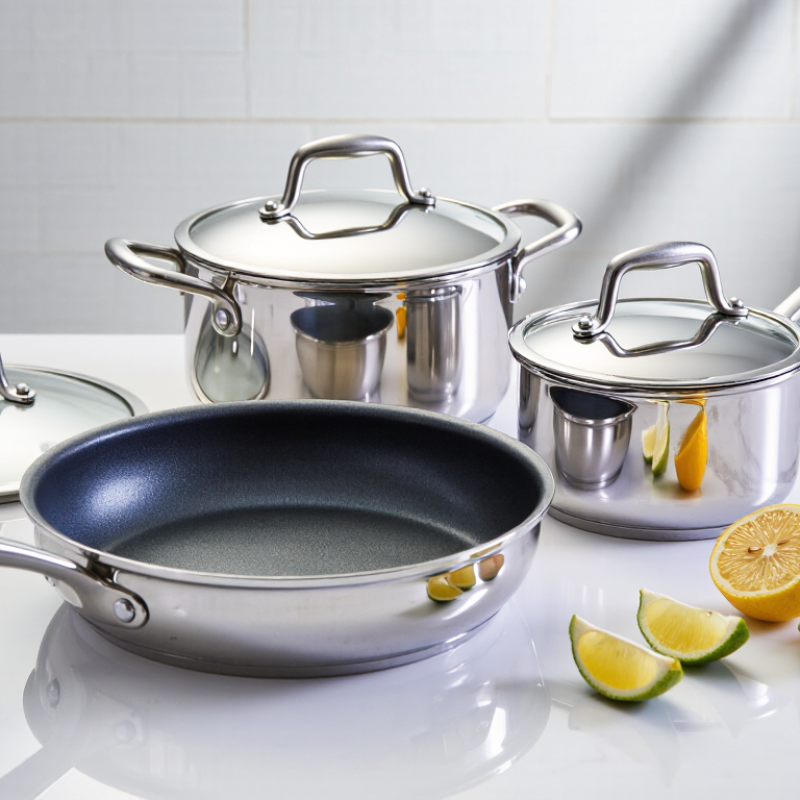
7 Tips for Choosing Stainless Non Stick Cookware

Understand How Stainless Steel Nonstick Cookware Is Made

Stainless nonstick cookware usually begins as a stainless steel body, shaped by stamping or spinning. Some pans use a single steel layer; others sandwich aluminum or copper between steel layers to spread heat more evenly. Check the product details rather than assuming every stainless pan has the same construction. The base and sidewalls can differ.

The cooking surface is made separately from the steel body. Manufacturers typically clean and prepare the interior, apply a primer, then add one or more nonstick layers and cure them with heat. Coatings vary, so look for clear information about their material and care limits. Small details matter. A smooth, even finish can make food release easier, but it does not guarantee long life. I have found that rough handling and metal utensils can leave marks sooner than expected. Not every pan is alike.

When comparing pans, inspect the rim, handle attachment, and base for neat, solid construction. A thick, flat base may sit more steadily on the cooktop, while a comfortable handle helps when lifting a full pan. Ask whether the coating covers only the cooking area or also reaches the sides. That can affect cleaning. Check the recommended heat range, too; overheating may shorten a coating’s useful life. It is easy to focus on the word “stainless” and overlook the surface that touches the food.

Match Cookware Construction to Your Cooking Needs

Stainless nonstick pans combine a steel exterior with a coated cooking surface, but their bases vary. For eggs and pancakes, a medium-weight pan with an aluminum core usually heats more evenly than a thin, single-layer body. That helps reduce pale centers and scorched edges. Check whether the base extends across the cooking surface or sits only beneath the center. Small detail, big difference.

For occasional searing, choose a sturdier pan with a thicker base. It can hold heat better when cooler food meets the surface, though very high heat may shorten a coating’s life. On induction, confirm that the outer steel is magnetic; appearance alone cannot tell you. Check the oven-safe limit for both pan and handle. Their limits may differ.

A riveted handle often feels secure, but food can collect around the joints. Mildly annoying. Match the pan’s size to your burner: a wide base over a small flame may heat unevenly. Consider how much weight feels comfortable when lifting a full pan, too. I’d also read the care instructions before buying, since some coatings call for moderate heat and nonabrasive utensils. One pan for every task sounds convenient, but that compromise may not fit your routine.

Evaluate Coating Safety, Durability, and Care

With stainless nonstick cookware, the steel body does not tell you what the slick surface contains. Check whether the coating is PTFE-based or ceramic, and read its temperature and care limits. “PFOA-free” alone does not describe every coating ingredient. Look for a technical sheet, not just front-label claims. Small marks count. If the coating flakes or has deep scratches, stop using the pan for cooking.

The German Federal Institute for Risk Assessment (BfR) warns that overheated PTFE-coated cookware can release hazardous gases. Its assessment places PTFE decomposition at about 360°C (680°F). That is not a normal cooking target, but an empty pan on high heat can approach it quickly. Use moderate heat, add food or oil before preheating, and ventilate the kitchen. Treat the figure as a warning, not a guarantee for every coating.

Durability depends on the coating and how it is used; stainless steel alone cannot predict lifespan. Choose wood or silicone utensils, let the pan cool before washing, and use a soft sponge. Skip abrasive powders and cold-water rinses on a hot surface. A quick check under bright light can reveal chips that rushed cleanup misses.

7 Tips for Choosing Stainless Non Stick Cookware – Evaluate Coating Safety, Durability, and Care

Tip What to Check Why It Matters Practical Guidance
1. Identify the cooking-surface coating Check whether the nonstick surface is PTFE-based, ceramic-based, or another coating; stainless steel may describe the body rather than the cooking surface. Coatings have different care requirements and performance characteristics. “Stainless steel” alone does not identify the coating. Look for clear product specifications and care instructions rather than relying on the cookware’s exterior description.
2. Read safety information carefully Check stated temperature limits, intended use, and relevant coating disclosures. “PFOA-free” does not necessarily mean “PTFE-free.” A single label may not describe the full coating composition or safe-use limits. If a particular coating type is important to you, confirm it from the product documentation or ask the seller for clarification.
3. Match the coating to your cooking habits Consider the recommended heat range and whether you often sear, preheat an empty pan, or cook delicate foods. Nonstick coatings are generally intended for low-to-medium heat, not prolonged high-heat cooking. Follow the maker’s temperature limits. Avoid overheating an empty coated pan; overheated PTFE coatings can deteriorate and release fumes.
4. Assess construction and heat distribution Review the base and layer construction, weight, handle attachment, and stated compatibility with your cooktop. Construction affects stability, responsiveness, and how evenly the pan heats; a stainless exterior alone does not guarantee even heating. For induction, verify that the cookware is specifically labeled induction-compatible. Choose a flat, stable base that suits your burner size.
5. Compare durability details, not promises Look for clear information about coating layers, use limitations, warranty coverage, and replacement or care guidance. Nonstick coatings can wear with use, and a warranty does not by itself establish how long a coating will last. Treat claims such as “scratch-resistant” as product-specific; check what the warranty excludes, including ordinary wear.
6. Check cleaning and utensil recommendations Confirm whether handwashing is recommended, whether the pan is dishwasher-safe, and which utensils are permitted. Harsh detergents, abrasive cleaning, and unsuitable utensils can shorten coating life; dishwasher-safe does not mean dishwashing has no effect over time. When instructions are unclear, use soft utensils and a non-abrasive sponge, and let the pan cool before washing.
7. Plan for careful everyday use Consider storage, pan size, handle comfort, and whether the cookware will be used frequently or mainly for delicate foods. Stacking pans without protection and cooking at excessive heat can cause avoidable wear. Use a pan protector or separate pans when stacking, avoid metal tools unless expressly allowed, and replace cookware if the coating is badly damaged or peeling.

Choose the Right Pieces for Your Cooktop and Kitchen

Start with the cooktop, not the cookware set. The U.S. Department of Energy’s Energy Saver guidance estimates induction transfers about 85% of its energy to cookware, compared with roughly 32% for gas. These figures are estimates, not a promise of lower bills. For induction, check that the pan’s base is magnetic and approved for your cooktop. Try a fridge magnet. If it sticks firmly, that is a useful clue, though the appliance manual is the better check. Stainless steel alone does not guarantee induction compatibility. Choose a flat, sturdy base that sits close to the heating zone; a warped or undersized pan may heat unevenly.

Then match the pieces to how you cook and where you store them. A 10-inch skillet suits many everyday meals, while a small saucepan takes less cupboard space than a large set of rarely used pots. Measure your cabinets and cooktop zones before buying. A wide pan can crowd neighboring burners, even if it fits on one. That detail is easy to miss. Look for handles that clear nearby pans and fit inside your oven, if you plan to use it there. For nonstick interiors, check the care instructions and avoid assuming every piece tolerates the same utensils or heat. I would rather have three useful pans than a tidy-looking set that blocks a drawer.

Compare Price, Warranty, and Long-Term Value

A low sticker price can hide a costly replacement cycle. Grand View Research estimated the global cookware market at about $26.7 billion in 2023 and forecast 6.3% annual growth through 2030. That report covers cookware broadly, not stainless nonstick lifespan, so treat it as market context—not proof that a costly pan lasts longer.

Compare price per year, not price alone. A $90 pan used for three years costs about $30 annually; a $45 pan replaced after eighteen months costs the same. These are examples, not lifespan promises. Check warranty length and exclusions: coating wear, overheating, and abrasive cleaning may not qualify. Read the care instructions, too. A warranty is not a durability test.

Look closely at the details you will handle: a flat base, secure rivets, and a smooth cooking surface. Consider whether the pan works on your stove and whether replacement parts are available. I have sometimes focused too much on the advertised warranty and too little on daily care. That can skew the math. Estimate how often you cook, then compare likely replacement costs with the warranty’s actual coverage. A longer warranty helps only when its terms match real wear.