What Are the 2026 Top Types of Outdoor Litter Bins?
Choosing the right Outdoor Litter Bins in 2026 requires more than comparing shapes, colors, and prices. Public spaces face heavier foot traffic, changing weather, and rising expectations for cleanliness. A bin beside a busy station must manage volume, odors, access, and collection speed. A small park bin needs a different balance. Context matters.
This guide examines the leading types of outdoor litter bins, including metal street bins, recycled-plastic units, wheeled containers, recycling stations, and smart sensor bins. Each option has practical strengths and weaknesses. Galvanized steel can resist impact, but damaged coatings may invite corrosion. Recycled plastic stays lightweight and colorful, yet extreme heat can affect durability. Sensor technology may improve collection planning, although it adds cost and maintenance demands. Real-world performance depends on installation, servicing, and user behavior.
Details matter. A narrow opening can reduce oversized waste, but it may frustrate users with limited mobility. A removable liner can speed cleaning, though poorly fitted liners may leak. Small mistakes become visible quickly. Good planning uses manufacturer data, site observations, accessibility guidance, and reliable waste-management experience. It also leaves room for honest review. No bin solves every environmental or operational problem.
The sections ahead compare design, capacity, materials, security, hygiene, accessibility, and long-term value. They also consider where each type works best, from school entrances to coastal promenades. The goal is practical selection, not fashionable purchasing. After all, the best bin is the one that remains usable, clean, and dependable after months of ordinary public use.
EN 840 Wheeled Bins: Standard Capacity Classes from 80 to 1,100 L
EN 840 wheeled bins remain practical choices for many outdoor litter collection points. Their standard capacity classes commonly range from 80 to 1,100 litres. Smaller 80, 120, and 240 litre bins suit courtyards, walkways, and low-traffic entrances. They are easier to move by hand.
Larger 660, 770, and 1,100 litre bins support parks, markets, transport areas, and busy commercial sites. The 360 litre class often sits between these needs.
Capacity alone does not determine performance. A 1,100 litre bin may reduce collection frequency, but it needs more turning space and a stable surface. Smaller bins can fit narrow paths, although they may overflow during weekend events.
That detail is easy to underestimate. EN 840 specifications also relate to wheeled construction, handling, and compatibility with lifting equipment. Buyers should verify the applicable standard part, dimensions, lid design, wheel configuration, and rated load before ordering.
Outdoor conditions demand more than a strong container body. UV exposure, rain, wind, and repeated impacts can shorten service life. Galvanised components, durable polymer walls, secure lids, and drainage-friendly designs can improve daily use.
However, material claims should be supported by test records, not sales language. I would also inspect wheel movement and lid alignment on a sample unit.
Small faults become expensive when hundreds of bins are deployed. Placement matters too.
A bin near a food area may need frequent emptying, even when its nominal capacity appears sufficient.
Street and Park Litter Bins: Compact 30–120 L Units for Pedestrian Areas
What Are the 2026 Top Types of Outdoor Litter Bins?
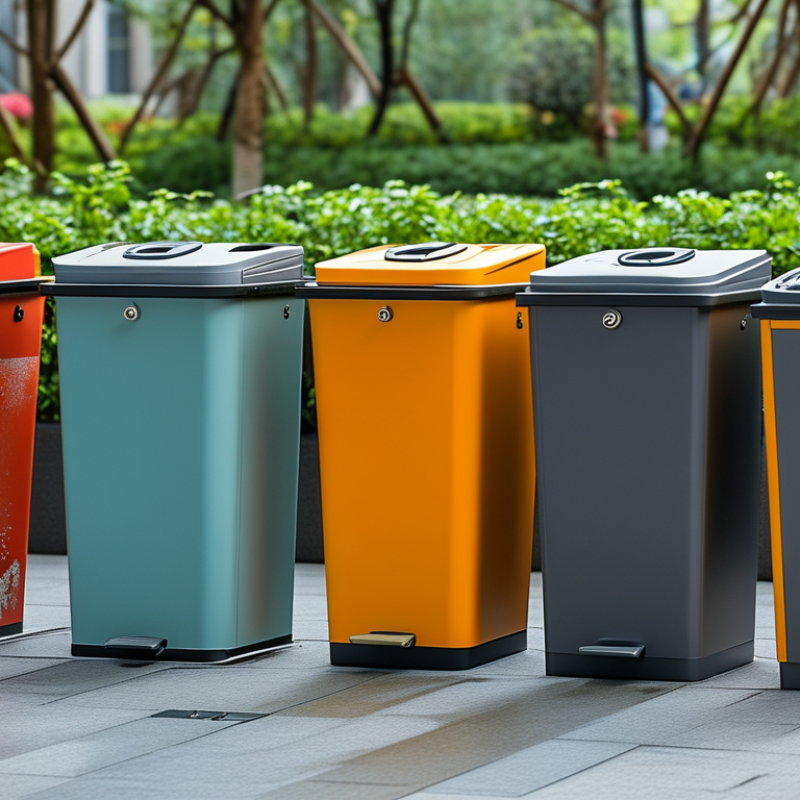
Street and park litter bins are becoming more compact, practical, and easier to service. For pedestrian areas, the most useful capacities range from 30 to 120 liters. Open-top bins suit busy walkways where quick disposal matters. Hooded and dome-top bins help reduce rain entry and discourage overflowing waste. Slim wall-mounted units save space near benches, crossings, and narrow paths.
I have found that 60-liter bins often balance capacity and collection effort. Larger 100–120-liter units work better near playgrounds, picnic lawns, and transit points. Integrated recycling compartments can improve sorting, but only when labels are clear. Otherwise, people may use the wrong opening. A perfect bin does not exist. Weather, foot traffic, and cleaning schedules change the result.
Tips: Check the liner size before ordering. Keep the opening visible. Use sturdy anchoring on exposed paths. Rounded edges make cleaning easier. Place bins beside natural walking routes, not behind landscaping. Test the lid with gloves on. Small details matter. A bin that looks attractive may still be awkward for older users or people carrying bags. Review fill levels for several weeks, then adjust capacity or placement.
Recycling Bins: Two- to Four-Stream Systems for Source Separation
What Are the 2026 Top Types of Outdoor Litter Bins?
Outdoor litter bins in 2026 are becoming sorting points, not simple containers. Two-stream units separate mixed recycling from residual waste. Three-stream designs may add food scraps, while four-stream units divide paper, containers, organics, and landfill waste. The right choice depends on foot traffic, collection capacity, and local material rules. Placement matters.
Near a school gate, a clear bottle opening can outperform a complicated slot. In a busy transit area, paired openings reduce hesitation and overflow. Color coding helps, but words and pictures matter more when users move quickly. A covered top protects paper from rain and limits windblown litter. Labels fade. They need inspection, not optimism.
Operational experience shows that extra streams are not automatically better. If crews collect two compartments together, source separation becomes mostly decorative. Bin interiors should use removable liners, rounded corners, and surfaces that tolerate frequent washing. Managers should record fill levels, contamination, odor, and damaged signage each week. One honest review may reveal that a smaller two-stream station works better than an impressive four-stream installation. Even then, user behavior can shift during festivals, storms, or seasonal tourism. Design must leave room for correction.
Solar-Compacting Bins: 120–240 L Units with Fill-Level Monitoring
What Are the 2026 Top Types of Outdoor Litter Bins?
Solar-compacting bins are becoming a practical choice for busy outdoor spaces in 2026. These units usually hold 120–240 liters before compaction. A built-in press can extend usable capacity several times, depending on waste type and loading patterns. That matters.
The World Bank’s What a Waste 2.0 report estimates 2.01 billion tonnes of municipal solid waste were generated globally in 2016. It projects 3.40 billion tonnes annually by 2050. UNEP’s Global Waste Management Outlook 2024 also identifies rising waste volumes as a major infrastructure challenge. Solar compacting bins cannot solve collection gaps alone, but they can reduce overflow between service visits. Fill-level monitoring sends usage data to maintenance teams, helping them schedule collection from actual demand rather than fixed routes.
A 120-liter unit may suit a quiet park entrance, while a 240-liter model fits transport hubs or food-service areas. Operators should check solar exposure, winter performance, battery condition, and sensor accuracy before installation. A shaded location may reduce charging reliability. Incorrect sensor readings can also create unnecessary visits. Not every site benefits.
In field planning, I would place these bins near pedestrian decision points, not hidden behind landscaping. Clear openings, sealed panels, and accessible maintenance doors improve daily reliability. Data should be reviewed after the first month. Early assumptions are often wrong. Separating general waste from recyclables still requires visible labels and consistent collection practices.
What Are the 2026 Top Types of Outdoor Litter Bins? - Solar-Compacting Bins: 120–240 L Units with Fill-Level Monitoring
| Bin Type | Nominal Capacity | Typical Compacted Holding Capacity | Fill-Level Monitoring | Solar Power Configuration | Typical Compaction Performance | Recommended Outdoor Locations | Key Operational Considerations |
|---|---|---|---|---|---|---|---|
| Compact Solar Litter Bin | 120 L | Approximately 240–360 L of loose waste equivalent, depending on material type and compaction settings | Ultrasonic or infrared sensor Remote fill alerts and collection-status reporting | Integrated photovoltaic panel with rechargeable battery storage | Typically reduces collection frequency by about 2–3 times compared with an equivalent non-compacting bin | Pedestrian streets, small parks, transit stops, school entrances and compact urban areas | Small footprint; suitable where installation space is limited. Performance can decline when the panel is shaded or heavily soiled. |
| Standard Solar-Compacting Bin | 180 L | Approximately 360–540 L of loose waste equivalent, depending on waste density and operating conditions | Ultrasonic fill-level sensor Configurable threshold notifications for route planning | Roof-mounted solar module connected to a protected battery compartment | Typically provides around 2–3 times the storage efficiency of a similar open litter bin | Commercial sidewalks, shopping areas, municipal squares, sports venues and busy public facilities | Balanced capacity and footprint. Sensor readings should be calibrated for irregular waste, liquids and objects placed above the sensing zone. |
| High-Capacity Solar-Compacting Bin | 240 L | Approximately 480–720 L of loose waste equivalent, depending on the waste stream and compaction cycle | Connected fill-level monitoring Optional temperature, door-status and service alerts | Larger photovoltaic surface with rechargeable battery designed for frequent compaction cycles | Typically reduces overflow risk and collection visits by approximately 2–4 times in suitable high-traffic applications | Transport interchanges, waterfronts, event districts, large parks and high-footfall pedestrian zones | Best for locations with sustained waste volumes. Requires adequate clearance for servicing, safe anchoring and regular inspection of the compaction mechanism. |
| Multi-Stream Solar-Compacting Station | 2 × 120 L or 2 × 240 L compartments | Approximately 480–1,440 L of loose waste equivalent across two compartments, depending on configuration | Separate sensor per compartment Independent fullness and access monitoring | Shared solar charging system with battery reserve for the complete station | Compaction efficiency varies by compartment and by material; mixed recyclables generally require separate operating settings | Airports, campuses, major stations, festival grounds and public recycling points | Supports source separation but needs clear labeling, controlled access and collection procedures matched to each waste stream. |
Note: Capacities and performance figures are typical specification ranges for outdoor solar-compacting litter bins. Actual results depend on waste composition, compaction-force settings, weather, collection frequency, battery condition, solar exposure and sensor calibration.
Specialized Bins: 20–120 L Dog-Waste and Cigarette-Litter Containers
Outdoor litter bins are becoming more specialized, especially for dog waste and cigarette litter. Keep America Beautiful’s 2020 National Litter Study estimated 50 billion littered items in the United States. It also found that 88% of littered items were smaller than four inches. These figures support targeted collection points, not only large general-purpose bins.
Dog-waste containers usually work well between 20 and 60 L in residential paths, parks, and apartment areas. Busy recreation zones may need 80 to 120 L capacity. A covered opening can reduce odors, rain entry, and contact risks. Cigarette-litter containers need narrower openings and fire-resistant internal materials. They should stand near entrances, benches, and designated smoking areas. The U.S. Environmental Protection Agency warns that pet waste can carry pathogens and add nutrients to waterways. Placement matters as much as capacity. A larger bin can still fail when servicing is irregular.
Tips: Match capacity with daily footfall, not guesswork. Check fill levels for two weeks. Keep dog-waste bins close to walking routes. Empty cigarette containers before they overflow. Warning labels help, but they do not replace convenient placement. Some sites may need more frequent collection instead of bigger bins. That trade-off is easy to underestimate.
What Are the 2026 Top Types of Outdoor Litter Bins?
Specialized outdoor bins typically range from 20 to 120 liters. Capacity selection depends on foot traffic, collection frequency, installation position, and whether the unit is designed for dog waste, cigarette litter, or combined use.
How to read the chart: Compact 20-liter bins suit low- to medium-use locations and wall-mounted cigarette-litter points. Larger 60- to 80-liter dog-waste and combined-use bins are better for parks, sidewalks, and transport areas with regular foot traffic. High-capacity 120-liter units are intended for busy public spaces or locations with less frequent collection.