Top 10 Tactical Apparel Manufacturers for Global Buyers
Choosing the right Tactical Apparel manufacturer requires more than comparing catalog photos and unit prices. Global buyers need dependable materials, consistent sizing, clear communication, and verifiable production capabilities. A jacket may look strong on a screen, yet weak stitching can appear after repeated washing or field use. Small details matter.
This guide examines ten manufacturers serving international markets, focusing on fabric performance, seam construction, customization, quality control, minimum order quantities, and delivery reliability. It also considers practical buyer concerns, including sample development, inspection procedures, ethical sourcing, and export documentation. These factors help procurement teams assess suppliers for lawful outdoor, security, workwear, and professional applications.
No ranking is perfect. Supplier capabilities can change with capacity, management, or regional disruptions. Product claims should be checked through samples, factory evidence, and independent inspections whenever possible. A manufacturer with impressive branding may still struggle with consistent color matching or late replenishment orders. That is worth remembering.
The selected companies represent different strengths. Some focus on durable field shirts and reinforced trousers. Others specialize in weather-resistant shells, high-visibility workwear, or private-label programs. Buyers should match each supplier to their real operating conditions, not simply choose the lowest quote. Ask about abrasion testing, wash performance, traceability, worker safety, and after-sales support. Reliable partnerships are built through documented standards and honest conversations, including difficult ones.
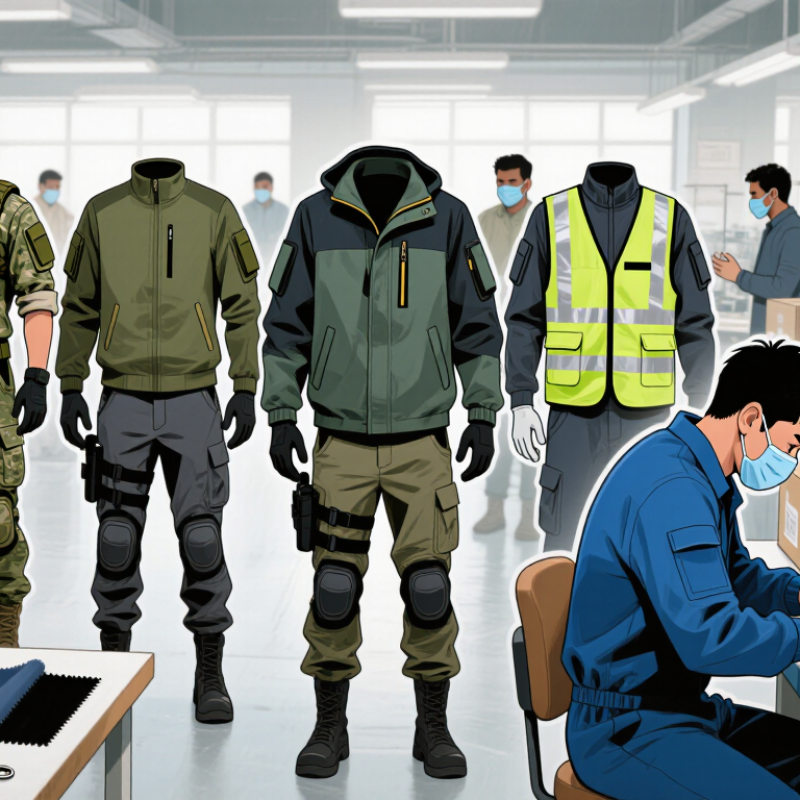
Defining Tactical Apparel and Its Global Market
Tactical apparel refers to purpose-built clothing designed for demanding outdoor, work, and professional environments. It usually combines abrasion-resistant fabric, reinforced stitching, practical pockets, weather protection, and comfortable movement. Unlike ordinary fashion, each feature should solve a clear problem. A durable jacket may protect against rain, while articulated trousers support climbing, kneeling, or long hours outdoors. Not every tactical design is equally useful.
The global market is expanding through demand from security services, emergency teams, outdoor professionals, and industrial workers. Buyers now compare fabric performance, size consistency, production capacity, and ethical manufacturing practices. Climate also matters. Lightweight ventilation suits hot regions, while insulated layers support colder markets. Certifications and test reports can improve confidence, but paperwork alone is not proof of field performance. A pocket may look strong and still tear under repeated use. That possibility deserves attention.
Tips: Ask manufacturers for fabric specifications, seam-testing data, wash-test results, and pre-production samples. Check zippers, hook-and-loop panels, waist adjustment, and pocket access by wearing the garment. Compare samples in realistic weather, not only in a showroom. Request clear information about factory quality control and delivery schedules. Start with a small order when possible. It reduces risk and reveals communication problems early. Experienced buyers should also review local labeling, chemical-safety, and import requirements before shipment. The process is rarely perfect, and honest feedback can improve the next production cycle.
Global Tactical Apparel Market Context: 2024 Military Expenditure by Region
Regional military expenditure provides a public, non-brand proxy for the scale of institutional demand that supports tactical apparel procurement.
Values are 2024 military expenditure estimates in billions of U.S. dollars. Source: Stockholm International Peace Research Institute (SIPRI), Trends in World Military Expenditure 2024.
Key Criteria for Evaluating Tactical Apparel Manufacturers
For global buyers comparing the top ten tactical apparel manufacturers, evaluation should begin with measurable performance, not catalog photography. Ask for fabric composition, abrasion results, colorfastness records, and size-grade samples. ISO 12947 Martindale testing can reveal how fabric handles repeated rubbing, while AATCC laundering methods expose shrinkage and color loss. A practical review should inspect bartacks, seam sealing, pocket reinforcement, and zipper operation after washing. Small details matter in wet, dusty, and high-movement environments.
Production control is equally important. The ISO Survey 2023 recorded more than 1.26 million ISO 9001 certificates worldwide, but certification alone cannot prove consistent garment quality. Request recent audit findings, corrective-action records, inspection rates, and batch traceability. Check whether the manufacturer can repeat the same measurements across three production lots. It sounds basic. It is often missed.
Material responsibility deserves closer attention. Textile Exchange’s 2024 Materials Market Report estimated global fiber production at 124 million tonnes in 2023, with polyester representing about 57 percent. Buyers should therefore verify recycled-content claims through transaction certificates and supplier records. Also examine wastewater controls, worker training, overtime practices, and emergency procedures. International Labour Organization guidance highlights the importance of safe working conditions in garment supply chains. A factory may pass an audit and still fail a field test. That uncomfortable gap requires independent sampling, realistic wear trials, and honest communication about defects, delays, and repair capacity.
Manufacturing Capabilities, Materials, and Product Standards
For global buyers, a capable tactical apparel manufacturer must prove more than stitching speed. Manufacturing audits should examine cutting accuracy, seam strength, humidity control, and production traceability. Small details matter. A loose bartack can fail under repeated load.
Material selection should match the working environment. Nylon blends offer abrasion resistance, while polyester can support faster drying and color stability. Textile Exchange’s Materials Market Report 2024 recorded 124 million metric tons of global fiber production in 2023. It also reported that recycled polyester represented about 12% of total polyester output. Buyers should request fiber-content verification, recycled-content certificates, and colorfastness test results. Sustainability claims need evidence, not attractive wording.
Product standards must be defined before sampling. ISO 13688:2013 provides general requirements for protective clothing, including ergonomics, marking, and information supplied by manufacturers. High-visibility designs may require EN ISO 20471 testing, where applicable. Factories should also test tensile strength, tear resistance, seam slippage, dimensional change, and abrasion after laundering. A technical file should link each result to a product version and batch number.
Certificates alone are not enough. I would inspect random finished units. One overlooked pocket seam can expose weak process control. Some suppliers also underestimate fit testing across different body shapes. That gap deserves correction.
Profiles of the Top 10 Tactical Apparel Manufacturers
Experienced buyers should inspect seam strength, shrinkage, colorfastness, and supplier communication before signing contracts. A factory may pass one audit yet miss details during peak production. That weakness deserves attention.
Reliable sourcing also requires pre-production samples, clear measurement charts, and independent quality checks. These manufacturers differ in specialization, but practical performance remains more important than impressive catalog language.
Sourcing, Compliance, and Selection Considerations for Global Buyers
When comparing the top ten tactical apparel manufacturers, global buyers should examine more than fabric weight and quoted prices. A reliable supplier can explain fiber content, stitching methods, colorfastness, and production tolerances. Ask for recent laboratory reports, not generic certificates. Small details matter. A loose seam near a pocket can become a costly field complaint.
Sourcing should begin with a documented factory review. Check production capacity, worker safety records, quality procedures, and subcontracting policies. Confirm whether the factory can maintain consistent sizing across repeated orders. Request pre-production samples and inspect zippers, reinforced panels, hook-and-loop areas, and wash performance. Compliance also includes accurate labels, packaging rules, chemical restrictions, and import documentation for each destination market. Requirements can differ sharply between regions.
Selection should balance price, performance, ethics, and delivery reliability. A low minimum order quantity may help testing, while stable lead times support long-term planning. Clarify payment terms, inspection points, defect allowances, and corrective-action procedures in writing. Traceable materials can strengthen buyer confidence, especially when recycled fibers or certified inputs are advertised. No supplier is perfect. A strong manufacturer admits limitations and proposes practical fixes. Buyers should also review their own specifications, because vague requirements create avoidable disputes. One overlooked measurement can affect an entire shipment. Expect questions from experienced suppliers. That is often a positive sign.
| Rank | Manufacturer Profile | Primary Product Focus | Recommended Fabric & Construction | Key Compliance Benchmarks | Typical Buyer Verification | Indicative MOQ | Indicative Lead Time |
|---|---|---|---|---|---|---|---|
| 1 | Premium Uniform Specialist | Field uniforms, combat shirts, tactical trousers | Poly-cotton ripstop or nylon-cotton blends; reinforced seat, knees, and stress points | EN ISO 13688 for protective clothing design and general requirements; restricted-substance controls under REACH where applicable | Size-set approval, seam-strength testing, colorfastness reports, factory audit, and pre-shipment inspection | 300–1,000 pcs/style | 45–90 days |
| 2 | Flame-Resistant Apparel Specialist | FR shirts, trousers, coveralls, and operational layers | Inherently FR aramid or FR-treated cellulosic blends; non-melting trims and compatible sewing thread | ISO 11612 for heat and flame protective clothing; ASTM F1506 only when the end-use electrical hazard requires it | Third-party thermal testing, wash-cycle durability, fabric composition verification, and certificate traceability | 200–800 pcs/style | 60–120 days |
| 3 | Technical Outdoor Apparel Specialist | Softshell jackets, rain shells, and cold-weather layers | Three-layer laminate, coated nylon or polyester, seam-sealed construction, water-resistant zippers | ISO 811 for hydrostatic water resistance; ISO 4920 for surface wetting; REACH chemical controls where applicable | Waterproof testing after laundering, breathability testing, seam-tape adhesion, and hood or cuff fit review | 300–1,000 pcs/style | 60–100 days |
| 4 | Law-Enforcement Uniform Specialist | Duty shirts, patrol trousers, and public-sector uniform programs | Durable poly-cotton or polyester ripstop; concealed closures and utility-pocket reinforcement | EN ISO 13688 where relevant; buyer-specific laundering, colorfastness, and dimensional-stability specifications | Tender-document compliance matrix, size grading, embroidery or badge placement approval, and social audit | 500–2,000 pcs/style | 60–120 days |
| 5 | Load-Bearing Textile Specialist | Tactical vests, chest rigs, belts, and utility pouches | High-tenacity nylon or polyester; bartack reinforcement, webbing load paths, and abrasion-resistant panels | Material composition and flammability requirements defined by the buyer and end market; REACH controls for EU sales | Tensile and tear testing, buckle-cycle testing, webbing inspection, load testing, and needle-detection controls | 300–1,500 pcs/style | 45–90 days |
| 6 | Cut-and-Sew Private-Label Specialist | Custom tactical shirts, hoodies, base layers, and casual duty wear | Buyer-specified knits or woven fabrics; custom labels, packaging, and graded patterns | Fiber-content labeling under destination-market rules; CPSIA testing for applicable U.S. children's products; REACH where applicable | Tech-pack review, lab-dip approval, print or trim testing, production sample approval, and labeling audit | 100–500 pcs/style | 30–75 days |
| 7 | High-Visibility Workwear Specialist | Reflective jackets, vests, trousers, and site-safety apparel | Fluorescent woven fabric with retroreflective tape and durable high-abrasion zones | EN ISO 20471 for high-visibility clothing; ISO 13688 general requirements; ANSI/ISEA 107 for applicable U.S. products | Visibility-class confirmation, luminance testing, reflective-tape wash durability, and dimensional inspection | 300–1,000 pcs/style | 45–90 days |
| 8 | Protective Knitted Apparel Specialist | Base layers, balaclavas, gloves, and cold-weather accessories | Moisture-management knits, stretch fabrics, flatlock seams, and low-bulk construction | OEKO-TEX Standard 100 may support harmful-substance screening; EN ISO 13688 applies only where the product is classified as protective clothing | Fiber verification, pilling and colorfastness tests, stretch recovery, wash testing, and skin-contact material review | 300–2,000 pcs/style | 30–75 days |
| 9 | Sustainable Tactical Textile Specialist | Recycled-fiber uniforms, equipment bags, and low-impact duty apparel | Recycled polyester or nylon with solution-dyed options and reduced-water finishing processes | GRS or RCS chain-of-custody documentation when making recycled-content claims; REACH controls for EU markets | Transaction certificates, recycled-content verification, wastewater records, restricted-substance testing, and supplier traceability | 500–2,000 pcs/style | 60–120 days |
| 10 | Rapid-Response Small-Batch Specialist | Prototype runs, replenishment orders, and short-season tactical collections | Stock-supported fabrics, modular patterns, and simplified trim configurations for faster production | Destination-market labeling, applicable chemical restrictions, and product-specific performance requirements | Capacity confirmation, material reservation, first-article inspection, AQL-based sampling plan, and shipment documentation | 50–300 pcs/style | 20–60 days |
| Buyer note: MOQ and lead-time figures are indicative international sourcing ranges, not guarantees. Confirm fabric availability, production capacity, testing scope, certification validity, import requirements, and social-compliance status directly with each shortlisted manufacturer before placing an order. | |||||||