
China Top 10 UPVC Fittings Manufacturers for Global Buyers
China has become an important sourcing destination for buyers seeking reliable piping components and production partners. Choosing among manufacturers, however, takes more than comparing a catalog or quotation. Upvc Fittings must suit the intended pipe system, working conditions, and installation requirements. Small details matter. A socket that looks right in a product photo may not match the dimensions or connection standard your project needs.
This guide introduces ten Chinese manufacturers for global buyers and offers a practical starting point for comparison. It considers factors such as product range, stated material specifications, quality-control practices, production capability, export experience, and responsiveness to technical questions. These details can help narrow a shortlist, but they should be checked directly with each supplier. Request current product data, dimensional drawings, test information, and samples where appropriate. Ask how batches are identified and how reported defects are handled.
There is no single best supplier for every project. Order volume, delivery schedules, customization needs, and local requirements can change the decision. A polished website is useful, but it is not proof of consistent production. Nor should one attractive sample settle the matter. Verify claims against documents and clear answers. This overview is not a substitute for technical review, and some details may change over time. Use it to ask better questions, compare manufacturers fairly, and choose a partner whose products and communication fit your project.
UPVC Fittings and Their Role in Global Piping Systems
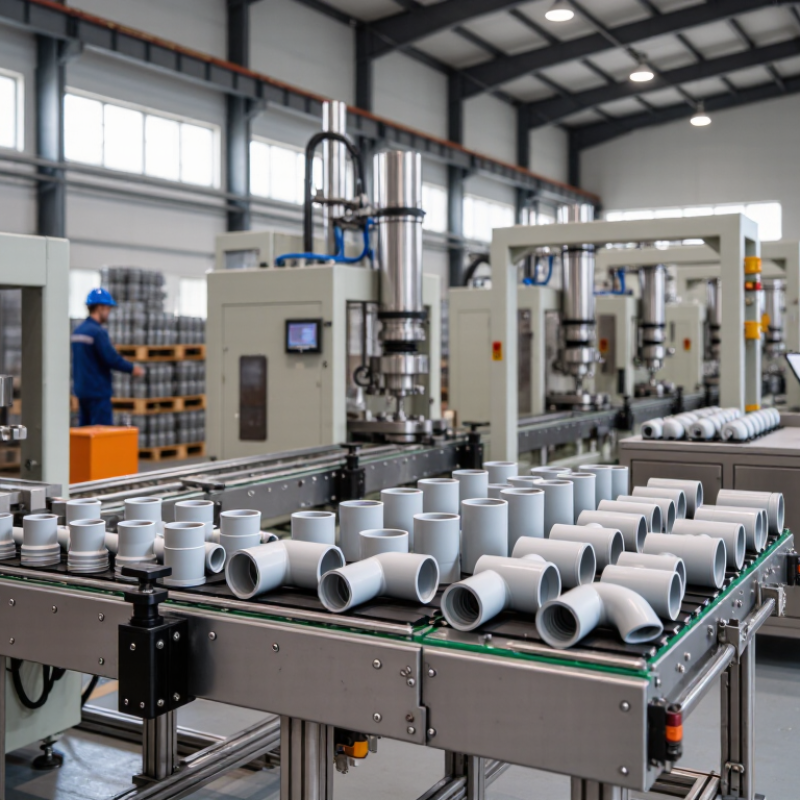
UPVC fittings connect pipes, control flow, and help create reliable routes for water and drainage. Elbows turn a line around a wall; tees branch toward separate fixtures; reducers join pipes of different diameters. These small parts shape how a larger piping system performs. They are light to carry and resist many common forms of corrosion, which makes them useful across residential, agricultural, and industrial projects. But they are not suitable for every fluid, temperature, or pressure.
Good installation starts with compatibility. Check the fitting’s dimensions, pressure rating, and intended service against the pipe and project requirements. During assembly, a clean, square cut matters. Remove burrs, dry-fit the pieces, and check alignment before applying the specified jointing method. A slight mismatch can cause stress at the socket. It may not show immediately. Support long pipe runs, too, since movement and uneven loads can strain connections over time. These details are easy to overlook on a busy site.
Global buyers should also review documentation and applicable local standards, because requirements differ between markets. Packaging and transport deserve attention: cracked sockets or distorted ends can complicate installation. UPVC is practical, not indestructible. Designers still need to consider UV exposure, temperature changes, and the system’s operating conditions. A fitting that looks right on a shelf may be wrong for the line.
China Top 10 UPVC Fittings Manufacturers for Global Buyers - UPVC Fittings and Their Role in Global Piping Systems
The table below compares ten commonly used UPVC fitting types and their roles in piping systems. It is a product-category guide, not a ranking of manufacturers. Product availability, dimensions, pressure ratings, and certification depend on the manufacturer and the applicable standard.
| Fitting type | Typical role | Common configuration | Typical system | Buyer checks |
|---|---|---|---|---|
| 90-degree elbow | Changes flow direction by 90 degrees. | Socket ends or other specified connection ends. | Pressure water or non-pressure drainage, depending on design and certification. | Confirm angle, end type, dimensions, and pressure or drainage standard. |
| 45-degree elbow | Provides a more gradual directional change than a 90-degree elbow. | Usually socket-ended; configurations vary by product range. | Water supply and drainage layouts where the system design permits. | Check the design standard and compatibility with the pipe series. |
| Equal tee | Creates a branch with the same nominal size as the main run. | Three sockets of the same nominal size in common designs. | Branch connections in water or drainage networks. | Verify all three end dimensions and the intended flow-system application. |
| Reducing tee | Branches from a main line to a smaller nominal pipe size. | One branch or outlet differs in size from the run. | Water distribution and drainage branches, subject to system requirements. | Confirm the size sequence and identify which outlet is reduced. |
| Straight coupling | Joins two pipe ends in a straight line. | Typically two socket ends; repair or transition versions may differ. | Joining pipe sections in compatible UPVC systems. | Check socket dimensions, joining method, and whether a repair coupling is required. |
| Reducer | Connects pipes of different nominal sizes. | Concentric or eccentric forms may be available, depending on the system. | Transitions between pipe sizes in water or drainage installations. | Specify both end sizes, geometry, and flow direction where relevant. |
| End cap or plug | Closes a pipe end or unused outlet. | Socket cap or other end closure, depending on the product design. | Temporary or permanent closure where permitted by the system design. | Check whether the closure is intended for pressure service and how it is joined. |
| Union | Allows a connection to be disconnected for maintenance without cutting the pipe. | Detachable body with compatible connection ends and a sealing element. | Accessible equipment connections in compatible piping systems. | Confirm seal material, connection type, and pressure and temperature limits. |
| Flange adapter | Connects UPVC piping to flanged valves, pumps, or other equipment. | UPVC pipe connection on one side and a flange interface on the other. | Equipment and valve connections in compatible systems. | Match flange drilling, facing, gasket, bolt pattern, and pressure rating. |
| Cleanout fitting | Provides access for inspection or clearing blockages in drainage lines. | Access opening with a removable threaded or otherwise specified closure. | Non-pressure drainage and soil-waste systems where specified. | Check access orientation, closure design, and compliance with local plumbing rules. |
Standards commonly encountered include ISO 1452 for plastics piping systems for water supply, ASTM D2466 and ASTM D2467 for specified PVC schedule fittings, ASTM D2665 for PVC drain, waste, and vent fittings, and ISO 4435 for underground non-pressure drainage and sewerage systems. Always confirm the exact edition, product scope, dimensions, and approvals required in the destination market.